Concern for Our Planet: Progressive Era Environmentalism

Facebooktwitterredditpinterestmail

I don’t think there is anyone in the 21st Century who isn’t aware and concerned about the effects of global warming on our planet. We’ve been hearing about it since the 1980s but, sadly, many people (including lawmakers) have been slow to do much about it. I’m guilty of this myself. But watching how my area of West Texas has become affected by climate changes in the past ten years (including more volatile weather during the spring months when tornado season hits and the heat wave we’ve been experiencing this year with most days over one hundred degrees), there is no doubt we are getting hit in the face with the consequences of modern human life and its toll on our planet.

The heat wave made me curious. After all, the Progressive Era was the doorway to our modern era in America, so I wanted to know how early 20th century Americans viewed environmental changes and whether they were aware of and concerned about the dangers. It turns out they were. In fact, there was an entire movement during the Progressive Era devoted to environmental issues. However, like the women’s movement, their focus was more on basic problems while the 21st century presents us with more complex problems.

As you may recall, suffragists’ first priority was to gain the vote. Their efforts were focused mainly on getting the 19th amendment passed (which happened in 1920). It was second and third-wave feminists who dealt with (and are still dealing with) the more complex issues of women’s reproduction rights, sexual harassment, equality in the workplace, and many more. 

With the environment, the more complex issues we’re dealing with today (such as carbon footprints, global warming, and recycling) weren’t on the agenda. Instead, environmentalism largely focused on conservation. These were issues such as making sure there were laws in place to preserve forests and timber for rural growth, poaching, and better access to clean water and sewage in big cities. Keep in mind the 19th century saw a lot of movement from rural areas to cities and growth in bigger cities, which made it necessary to put preserving natural resources and land on the agenda.

Photo credit: Theodore Roosevelt (third from the left) and environmentalist John Muir (second from the right) in “The Land of the Giants” at Yellowstone National Park, 1903, Harvard College Library: Adventure George/Flickr/Public Domain Mark 1.0

We were lucky we had an ally in the highest form of government: President Theodore Roosevelt. I mention here how Roosevelt was a great outdoorsman, and he was also a responsible one. He had a great concern for the environment and, under his administration, there were laws passed to preserve natural resources and make sure big businesses didn’t exploit and drain our natural resources.

In my Adele Gossling Mysteries, Adele’s sidekick, clairvoyant Nin Branch plays the role of the environmentalist. She isn’t involved in the conservation movement officially (though as the series progresses, who can tell?) but she has a deep connection to the environment and to animals (in Book 4, the book I’m working on right now, she does no less than charm a lion!) and a great concern about natural resources. She knows the potency of the earth and also its gifts and uses that knowledge in Book 2 of the series.

Speaking of Book 2, A Wordless Death just came out last week! You can find out where here

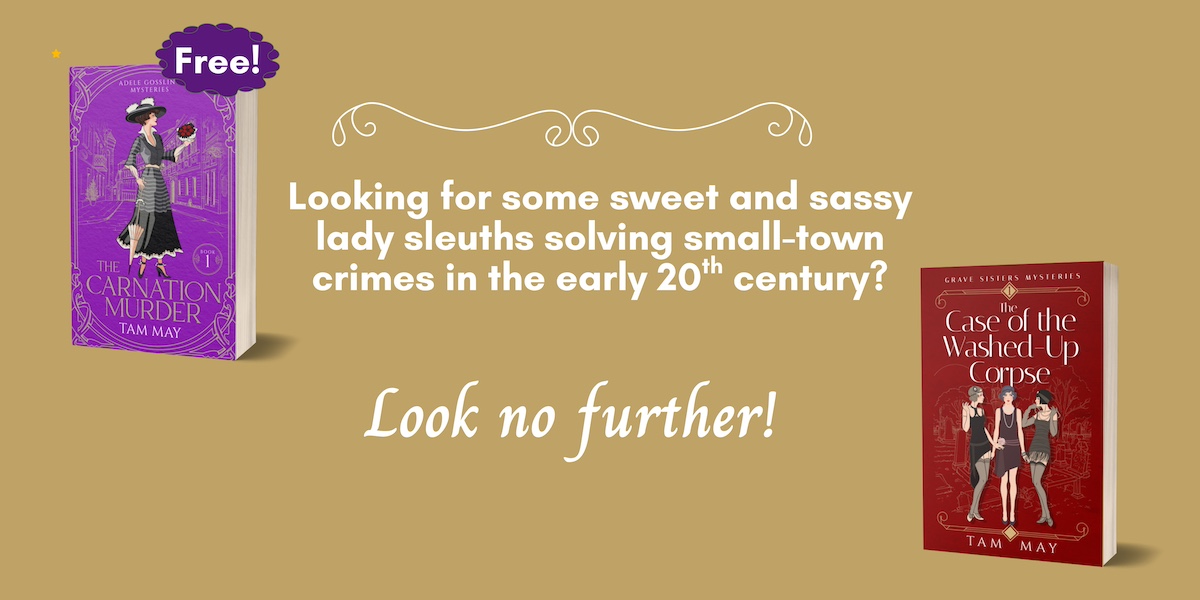
If you love fun, engaging mysteries set in the past, sign up for my newsletter to receive a free book, plus news about upcoming releases, fun facts about women’s history and mystery, and more freebies! You can sign up here

instagram
Facebooktwitterredditpinterestmail

Impulses and Madness: The History of the Insanity Plea

Facebooktwitterredditpinterestmail

This last month, in honor of the release of my book, A Wordless Death, I wrote a series of newsletters for my newsletter subscribers about the 1914 murder of a New York schoolteacher named Lida Beecher. You can read a little about that case here

One of the fascinating things about this case is that it brought to the forefront the insanity defense in court cases in the 20th century. The insanity defense is when the defense lawyers claim the defendant was insane at the time he or she committed the crime. The caveat is the defense has to prove the accused had no conception of what he or she was doing when he or she committed the crime and had no concept of the moral or legal consequences of that behavior. To put it simply: They have to prove the defendant didn’t know what he or she was doing at the time of the crime and that what he or she was doing was morally wrong with legal consequences.

The insanity plea has actually been around since the mid-19th century. It was first used in Britain when a man standing trial for attempting to shoot the Prime Minister was acquitted when the jury decided he was psychotic and acting under the belief that the Prime Minister was conspiring against him. The insanity plea was used rarely throughout the years until the Leda Beecher case brought it back. In that case, the plea that Jean Gianini was innocent due to criminal imbecility (based partly on his results on the Binet test which found him to have the mental capacity of a ten-year-old even though he was sixteen) was accepted by the jury and Gianini was saved from the electric chair. Not that his fate was much better, as he was confined to a mental institution until his death in the 1980s. 

Photo Credit: Matteawan State Hospital for the Criminally Insane, where Jean Gianini spent most of his days after his trial, ariel view, 1926, War Department, Army Air Forces, National Archives at College Park: Ooligan/Wikimedia Commons/PD US Government

The difficulty of the insanity plea is obvious: Is the defendant really insane with no concept of right or wrong or that he or she had even committed a crime? Or is the defendant just putting on a good show? The controversy over the insanity defense stems from this, as many people believe most are shamming. Take the film Anatomy of a Murder (1959), which was based on a real case that occurred in 1952. In the film, an army lieutenant is accused of shooting a man who had raped the lieutenant’s wife. The defense uses the plea of “irresistible impulse,” a variation of the insanity plea. In the film, we see the defense attorney constantly coaching the defendant on what to say and how to behave to convince the jury of his insanity. And it ends up working. Like Gianini, the lieutenant is saved from the electric chair. 

We see the insanity plea used so much on TV and in films (because it makes for great drama) that we might think it’s used very often. In the early 20th century, when my Adele Gossling Mysteries takes place, it was used quite a bit in court cases. But in the 21st century, we’ve gotten wiser and perhaps more cynical. In fact, the insanity plea or a variation of it is used in less than one percent of court cases. And of those one percent, only about a quarter are accepted. It all boils down to whether juries are buying that someone, even if they are mentally ill or emotionally unstable, could really not comprehend either what he or she is doing or that what he or she is doing is wrong. Those cases where the plea is accepted usually show the defendant as having a long history of severe mental illness. 

Does mental illness or the insanity plea play a role in A Wordless Death? You can find out by getting your hands on a copy of the book. It’s still on sale at a special launch price, but not for long! All the details and links to book vendors are here

If you love fun, engaging mysteries set in the past, sign up for my newsletter to receive a free book, plus news about upcoming releases, fun facts about women’s history and mystery, and more freebies! You can sign up here

instagram
Facebooktwitterredditpinterestmail

Technology, Railroads, and Women: Sacramento During the Progressive Era

Facebooktwitterredditpinterestmail

If you’ve been reading my books, you know my fiction is set in San Francisco and the Bay Area. I mention a little about my story with San Francisco in my author biography (which you can find by clicking on the About Pages on the menu bar above). San Francisco was the place of both my psychological and literary maturity back in the 1990s.

So why is this blog post about Sacramento? First, parts of Book 2 of the Adele Gossling Mysteries take place in Sacramento. And second, I became interested in Sacramento’s history unexpectedly.

Back when I was writing my Gilded Age family saga, the Waxwood Series, I had a chance to visit Benicia, California, a small coastal town not far from San Francisco. I was so fascinated by the lovely surroundings and the way Benicians took their history seriously that it became an inspiration for the town of Waxwood. I wrote about that here

What does Benicia have to do with Sacramento? In my research, I found out Benicia was, for a very short time, the state capital before legislators settled on Sacramento. In fact, Sacramento had to fight five cities for the honor of state capital, including Monterey, San Jose, and Benicia. 

Photo Credit: Sacramento State Capital building, 1910, postcard, Goeggel & Weidner, Publishers, San Francisco: greghenderson2006/Wikimedia Commons/PD US expired

What Sacramento had to offer might not seem like competition with the charm of coastal towns like Monterey and Benicia. And, in fact, the choice of Sacramento as the state capital was almost incidental and certainly very practical. After moving the capital around five cities within five years, legislators accepted Sacramento’s offer to use their home ground as a state capital — and it stayed there. Not a very exciting story but history is filled with stories that aren’t all that exciting.

What Sacramento had going for it at the turn of the 20th century, however, was something else. It took the Progressive Era ball and ran with it. For example, people were slow to embrace the automobile since its inception in the late 19th century, but in 1900, the first car appeared in Sacramento (for comparison, people started buying cars only when the 1908 Ford Model T made them more affordable.) The first automobile race took place during the California state fair in Sacramento in 1903 (the year the Adele Gossling Mysteries begins). People who have read Book 1 are familiar with the opening of Adele roaring down the main street in her Beaton Roundabout (a fictional car manufacturer) and causing a shock among the town’s Victorian-minded residents. You can bet if it had been Sacramento instead of Arrojo, people wouldn’t have turned a hair!

Another area of progress Sacramento embraced was worker’s rights and free commerce. Tired of the Southern Pacific Railroad domination (a company run by San Francisco giants like Leland Stanford, Mark Hopkins, and Charles Crocker), Sacramento politicians allowed the Western Pacific Railroad to build tracks in the city, giving many workers jobs and helping to put a halt to the SPR’s cartel over railroad transportation in the West.

And let’s not forget the women! We know women’s suffrage was a big issue for the progressives and women fought to gain the vote, which they did in 1920. But in Sacramento, as in all of California, women already had the right to vote in 1911. In the years following before the ratification of the 19th Amendment, women in California were already making strides with their vote, such as encouraging Chinese-American women to go to the polls (with the first going in 1912) and putting Native American suffragism on the political agenda. 

Sacramento may not be as famous as San Francisco, but if you want to read a bit about life in that city, take a look at A Wordless Death coming out at the end of this month. You can pick up a copy at a special price for preorder here. And how about Book 1? That’s on sale too! Get all the information here

If you love fun, engaging mysteries set in the past, you’ll enjoy my novella The Missing Ruby Necklace! It’s available exclusively to my newsletter subscribers and you can get it here. By signing up, you’ll also get news about upcoming releases, fun facts about women’s history, classic true-crime tidbits, and more!

instagram
Facebooktwitterredditpinterestmail

A Gilded Age New Year

Facebooktwitterredditpinterestmail

Photo Credit: Fanciful sketch of a New Year’s Eve celebration, Marguerite Martyn, 1914, St. Louis Post-Dispatch, 4 January 1914, Editorial Section: BeenAroundAWhile/Wikimedia Commons/PD US

Since this is the holiday season, I’ve been reflecting on the holidays in history, particularly in the 19th century. I wrote about Thanksgiving and Christmas in the Gilded Age. No holiday discussion could be complete without New Year’s.

New Year’s in the 19th century was then, as it is today, about seeing off the old year and bringing in the new. In the earlier part of the century, celebrations were rather modest. It was not uncommon to have a “watch night” on New Year’s Eve where people (especially in rural areas) would watch and wait for the clock to strike midnight so they could leave their old sins behind and begin the new year fresh to commit new ones.

Gilded Agers turned New Year’s into a real party holiday for the same reasons they turned Thanksgiving into a dining extravaganza: They wanted to show off. So they threw lavish parties and “invitation only” balls that included eight-course dinners and plenty of champagne even before the clock struck midnight. There are anecdotes about these Gilded Age party-goers, most of them wealthy, who were indeed determined to leave their sins behind them in the old year. It was not uncommon for them to go from house party to house party, making complete fools of themselves, and getting their names in the society columns the next morning. What a way to start the new year!

There were other traditions that are staples of New Year’s which came in the 19th century. One of them is the song “Auld Lang Syne,” a sentimental farewell to old friends and experiences. The song was actually an 18th century ballad composed by Scottish poet Robert Burns, and the tradition of singing it at midnight on New Year’s Day began in the mid-19th century, though it wasn’t until later in the 1920s that it became a permanent staple of our New Year’s tradition.

And the famous New Year’s Eve ball, that gigantic globe of light that drops at midnight every year in Times Square? That originated on New Year’s Day in 1905. The original ball was seven hundred pounds of iron and wood with a hundred light bulbs. The ball has been updated several times, the last in 2008, so it now weighs over twelve hundred pounds. Rather than lowered by hand with ropes as the original ball was, it now has a laser atomic clock located in Colorado.

I don’t think it’s a far stretch to say we still do, in a way, have our “watch night” where we wait impatiently for midnight to strike so we can let go of the old year’s sins and enter the new fresh. In fact, the reason New Year’s Day is on January 1st has to do with just that idea. Julius Cesar was the one who implemented the new calendar year to begin on that day, naming the first month of each new year January after Janus, the Roman god of new beginnings. Janus has two faces — one face facing front and the another face in the back of his head. Why? So that he can look back to the past and look forward to the present and future. For anyone who has read my fiction, this is exactly what my characters do. So, in essence, if I had to chose a holiday that belonged to the Waxwood Series, it would be New Year’s.

Want to read about how Vivian Alderdice looks back into the past to find her future? Start reading the Waxwood Series for only 99¢! Get all the information here

Is the life of a Gilded Age debutante all parties and flirtations? Read “The Rose Debutante” to find out! It’s FREE! Plus, you’ll get to know about life in the past and about the resilient women the history books forgot. And how about fun historical facts, great deals on historical fiction books, and a cool monthly freebie thrown in just because? Here’s where you can sign up.

instagram
Facebooktwitterredditpinterestmail

Thanksgiving in the Gilded Age

Facebooktwitterredditpinterestmail

Photo Credit: Thanksgiving family at dinner. No date on the image, but based on the hairstyle and clothes, I’m guessing this is probably around the 1880s or early1890s: Linnaea Mallette/Public Domain Pictures/CC0 1.0

Today is Thanksgiving in the United States. Thanksgiving is traditionally a time of gratitude and giving and many people have a big dinner with “all the trimmings” where both family and non-family members are invited. Although my family isn’t US-born, my parents adopted the Thanksgiving traditions and my mom always had a huge turkey and many of the trimmings (somehow, the sweet potato casserole with marshmallows was always missing…) and we always enjoyed it as a family.

The Waxwood series is set in the Gilded Age, which took place roughly in the last quarter of the 19th century. The series involves a wealthy Nob Hill family. How would the Alderdices celebrate Thanksgiving? Did they celebrate it at all?

Gilded Age aristocracy did indeed celebrate Thanksgiving but not the way we do now. For many of us in the 21st century, Thanksgiving means a large table crowded with food, fall colored table settings, lots of kids and grandparents and aunts and uncles. Rosy cheeks, laughter and family jokes abound. Our vision of Thanksgiving is like something out of a Norman Rockwell illustration.

Photo Credit: “Thanksgiving dinner, Occidental Hotel, San Francisco, CA, 1891, scan by New York Public Library: Fee/Wikimedia Commons/PD scan (PD US expired)

But the aristocrats of the Gilded Age weren’t quite so committed to the idea of a family Thanksgiving. In fact, Gilded Age swells didn’t stay at home — they dined at the fanciest restaurants or hotel dining rooms. It was not unusual for Gilded Agers to feast on non-traditional Thanksgiving fair such as oysters, turtle soup, foie gras, prime rib, and Petit fours. The Thanksgiving menu at the Occidental Hotel in San Francisco (one of the swankiest of its day) hardly looks like the usual turkey with cranberry sauce, mashed potatoes, and pumpkin pie most Americans feast on nowadays.

We might be led to believe wealthy Gilded Agers weren’t as family-oriented as we are today, but as I pointed out in my blog post about the Gilded Age, people in this period in American history were obsessed with excess and an “over-the-top” feasting on life, especially those who could afford it. A family dinner at home simply didn’t fit in with their lifestyle. An extraordinary dinner at a fine hotel did, and many Gilded Agers used it as an excuse to show off their wealth and affluence with lavish clothes and jewelry. Many went to see and be seen.

If that sounds petty, keep in mind the concept of a family Thanksgiving was foreign to the Pilgrims as well. Pilgrims in the 17th century celebrated Thanksgiving with their neighbors and friends, often times without members of their families present, as many stayed behind in England or perished on the journey to America. Historians cite the 1920s Prohibition era and the Great Depression that follows as reasons why elaborate Thanksgiving festivities of the Gilded Age fell out of favor. That might be, but I’m guessing it had more to do with the post-World War II era when the family became more precious and important to Americans. This is why Rockwell’s illustration became so much a part of the American psyche and Thanksgiving associated with an intimate portrait of family.

Book 1 of the Waxwood Series, The Specter, gives the reader a taste of Thanksgiving in the 19th century. The holiday takes place in April, not November. In fact, until Franklin Roosevelt signed a proclamation making the third Thursday of November the official Thanksgiving holiday, you could find the day of thanksgiving during several different times of the year depending upon the state. If you’re curious, you can read more about that here

The Waxwood Series has just gotten a make-over! To find out more about the series, this page will give you all the details.

Is the life of a Gilded Age debutante all parties and flirtations? Read “The Rose Debutante” to find out! It’s FREE! Plus, you’ll get to know about life in the past and about the resilient women the history books forgot. And how about fun historical facts, great deals on historical fiction books, and a cool monthly freebie thrown in just because? Here’s where you can sign up.

instagram
Facebooktwitterredditpinterestmail