All Decked Out: Easter in the Gilded Age

Facebooktwitterredditpinterestmail

Photo Credit: Let all rejoice sweet Easter Day, 1881, stock card, published by Geo M. Hayes, Boston Public Library, Print Department: Boston Public Library/Flickr/CC BY 2.0

It’s officially Easter and, if you’ve been reading my blog, you know that I love to dive into the way things were during the holidays. The Gilded Age made of Easter what it made of many other holidays — an opportunity for opulence and excess. But, then, Gilded Agers knew how to enjoy life.

Easter in America didn’t become a spectacle until after the Civil War. In the first half of the 19th century, it was an important holiday for Christians and Catholics, but some religious groups were apt to ignore it. Others made Easter Sunday a day of mourning the fallen soldiers of the war. 

But things began to change around the 1870s (which coincides, not coincidentally, I think, with the birth of the Gilded Age). Easter was still, of course, a religious holiday and honored as such, but the Gilded Age mentality began to slip in. Gilded Agers saw it as a time to celebrate spring in the best way they knew how — by showing off.

Now, here’s a cartoon that is a sign of the times: An elderly Victorian lady dressed to the nines points toward a lavish Easter bonnet on a maypole while other equally garish women gather around to worship this sign of Gilded Age opulence. But the New Woman isn’t buying it and, in her sensible and comfortable suit, gives her a look like, “Seriously?”

Photo Credit: She won’t bow to the hat, C. J. Taylor, 1896, Library of Congress, Chromolithographs: Picryl/No known restrictions

The tradition of new Easter clothes took off during this period. Easter was the perfect time to jump into spring with bright, pastel shades and adornments. As with other holidays, such as Christmas, consumerism ruled, and it suddenly became a necessity rather than desirable for women and men to get new clothes for the holiday. Advertisements for men’s clothes urged them not to wait to order their new Easter suits, and buying a new hat for the holiday was the order of the day for most women (thus was born the “Easter bonnet”). As you can see from the photos on this page, not a ribbon or a frill was spared on these elaborate headgear. 

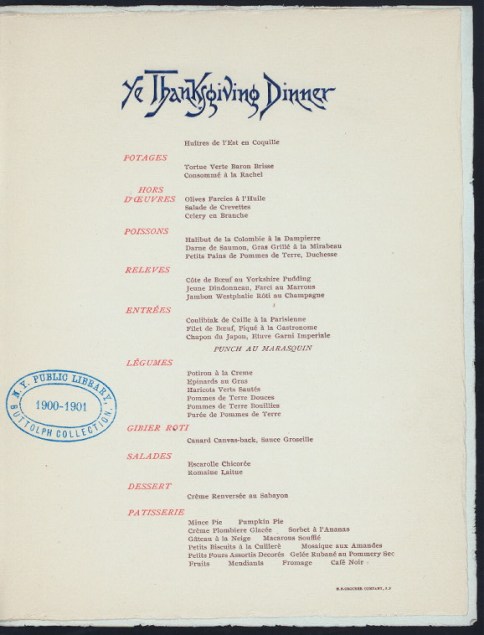
Where did Gilded Agers take themselves to display their new Easter garb? To church, obviously. In fact, there were those who weren’t regular churchgoers but would make an exception for Easter Sunday so their fellow worshipers could admire their new spring clothes. Another place Gilded Agers went to see and be seen in their new Easter garb was restaurants and hotels. Just as with Thanksgiving, hotel dining rooms had special menus for Easter that might have included lamb and asparagus (a vegetable just coming into vogue in Victorian cuisine). And the height of showing off in the Gilded Age was the Easter parade. In fact, the idea of the parade was conceived when aristocratic Victorian ladies flocked down Fifth Avenue dressed in their finest after church. In 1948, the musical Easter Parade, starring Judy Garland and Fred Astaire epitomized this Easter tradition, especially in this song where Garland tackles all the cliches of Easter in one tune.

Want to read about one Nob Hill family and their rise and fall in the Gilded Age? My entire Waxwood Series is now available!

Want to explore the nooks and crannies of history that aren’t in the history books? Like social and psychological history and not just historical events? Want in on exclusive sneak peeks, giveaways, and surveys? Then sign up for my newsletter! You’ll get a free short story when you do.

instagram
Facebooktwitterredditpinterestmail

The 19th Century Bluestocking

Facebooktwitterredditpinterestmail
19th century, bluestocking, women, intellectual, Gilded Age, fiction, novels, family saga, 18th century

In this caricature, made at the end of the Blue Stocking Society heyday, the disbanding of the club can only be seen in terms of violence and hysteria because women who didn’t fit the mold of the “angel in the house” were seen in this way. So in the thinking of the male artist, even their intelligence and wit can’t save them from behaving like women!

Photo Credit: Breaking Up of the Blue Stocking Club, Thomas Rowlandson, 1815, hand-colored etching, Metropolitan Museum of Arts, Drawings and Prints: TemboUngwe/Wikimedia Commons/CC0

In Pathfinding Women, the third book of my Gilded Age family saga, the young women of her wealthy society accuse the protagonist Vivian Alderdice, of being a “bluestocking.” Like many terms referring exclusively to women, this one has positive origins but became negative with time.

The term referred to an actual 18th-century British club called the Blue Stockings Society and was created as a place where both women and men (though mostly women) could discuss literature and the arts. The name comes from a type of casual dress style (the worsted wool “blue” stocking) which was generally not considered proper dress for anyone but the peasants (ironic, considering the group was made up of well-to-do people, and its aim was to discuss formal topics…).

The society was led by author and social reformer Elizabeth Montagu. Montagu provided a place for intelligent and privileged women such as playwright Hannah More and author Frances Burney a safe place to bring forth their passion for the arts and gain support from fellow enthusiasts. The club was active and popular until the late 18th century, and, looking back at history, we might understand why. As I wrote here, the philosophy of the separate spheres began to take precedence in the thinking of intellectuals about the role of women and men in society around this time. Women, remember, were regulated mostly to the private sphere, destined to take care of their family and limit their public interest to church and charity. Thus, intellectual pursuits for women were discouraged, and any woman who didn’t fit the mold was looked upon in a negative light.

This is also why the term “bluestocking” began to take on unflattering connotations in the 19th century. These women were seen, by Victorian standards, as unmarriageable either because they were too unattractive, too old, too educated, or any combination of the three. They were a nuisance in society, trying to compete with intellectual men (and unable to, of course). Many caricatures went out during this time about the bluestocking (like the one by Rowlandson above).

So it’s no surprise when the wealthy young women of Nob Hill in my book get catty, the first thing they do is insinuate that Vivian, because she prefers books to flirtations, is a bluestocking. At one point in the novel, Vivian laments:

“Her daily walks made her less fragile than Amber and her friends and she had heard sniffing remarks on her “bluestocking” pursuits in pockets of parties and after-dinner conversations.”

Despite the fact that Vivian is a progressive young woman, she falls victim to the stigma attached in the Gilded Age to any “bookish” unmarried woman and asks her mother in a worried tone, “Do you think he [Monte Leblanc, the man she’s pursuing] has the notion from Fern that I’m a bluestocking?” Her mother reassures her Mr. Leblanc has no such idea.

If you’d like to take a look at Pathfinding Women, you can do so here. To find out more about the series, you can go here. You can also find information on Books 1 and 2 of the series here and here. Book 4 of the series, Dandelions, will be coming out in December 2020, so come check it out here

Want to explore the nooks & crannies of history, the stuff that isn’t in the history books?Like social and psychological history and not just historical events and dates? Want in on exclusive sneak peeks, giveaways, and polls? Then sign up for my newsletter! Plus, you’ll get a free short story when you do :-). Here’s the link!

instagram
Facebooktwitterredditpinterestmail

The History of Father’s Day in the United States

Facebooktwitterredditpinterestmail

Photo Credit: Story Time (Portrait Of The Artist`s Father And Daughter), Ekvall Knut, 1843-1912, taken 11 April 2013 by Plum leaves: Plum leaves/Flickr/CC BY 2.0

Last month, I wrote a blog post about the history of Mother’s Day. In honor of Father’s Day, which this year will be on Sunday, June 21 in the United States, I’m taking a look back at the history of Father’s Day too.

Unlike Mother’s Day, which has definite origins, the history of Father’s Day is a little more vague. There were, in fact, two local celebrations going on during the Progressive Era that are thought to be the official kick-off of Father’s Day, both celebrated for personal reasons. In 1910, Sonora Smart Dodd, inspired by Mother’s Day, which was becoming a popular holiday at that time, campaigned in her home state of Washington for an official Father’s Day celebration in June, largely wanting to commemorate her own father, who had been a Civil War veteran and raised her and her five brothers and sisters alone on a farm when his wife died in childbirth. She succeeded, as Washington began celebrating a state-wide Father’s Day that year. The other celebration happened on a wider but no less personal scale. Two years earlier, in West Virginia, a local Methodist church in Fairmont celebrated the day in honor of 361 fathers who were killed in a local mining explosion.

But as far as official lobbying and support goes, this was slow in coming. There were national political figures, such as William Jennings Bryan and Calvin Coolidge who supported a national Father’s Day, but these recommendations didn’t get much traction. There are several reasons for this. As many of us know, Mother’s Day has becomes a commercially viable holiday and was that way from very early on. It was, in fact, its commercial appeal that helped get Woodrow Wilson to sign a proclamation declaring it a national holiday in the United States in 1914. But many felt that fathers just didn’t have the same monetary appeal as mothers, mainly because the sentiment attached to mothers from the long history of the separate spheres wasn’t attached to fathers. As I discuss here, the role of the father in the 19th and early 20th century was more of a teacher and disciplinarian. The same sentimentality also seemed to undermine the idea of the “manly man”, emphasizing the masculinity crisis, especially in the late 19th and early20th centuries. 

There were even some int he 1920’s and 1930’s who lobbied to abolish Mother’s Day and, instead, create an overarching Parent’s Day, arguing that it wasn’t the separate role of the mother, or the father, for that matter, that should be celebrated — it was the institution of parenthood that deserved the celebration (and my home country, Israel, went a step further and abolished Mother’s Day and Father’s Day in the 1990’s in favor of Family Day). But the lobbying for a Father’s Day was strong and in 1972, Richard Nixon declared Father’s Day a national holiday on the third Sunday of June in the United States.

Fathers play a role in my Waxwood Series, though in a less conventional way than in most books. In False Fathers, Book 2 of the series, Jake Alderdice’s biological father is absent and, instead, his entire life had been filled with substitute father figures. It’s one of these figures that leads him to both chaos and maturity in the book.

Want to grab a copy of the book for Father’s Day? False Fathers is at a special price through Sunday. You can find out more about it and buy it at your favorite online retailer here. To find out more about the series, you can go here.    

instagram
Facebooktwitterredditpinterestmail

The Problem That Has No Name

Facebooktwitterredditpinterestmail

Photo Credit: Silhouette of woman’s face in a question mark, uploaded 9 February 2019 by Mohamad Hassan: mohammad hassan/Pxhere/CC0 1.0

This month, I’ve been talking a lot about Betty Friedan and her book, The Feminine Mystique, because the ideas in that book were an inspiration for the stories in the new edition of my first book Gnarled Bones and Other Stories. How that came to be, I go into in the Forward of that book.     

I was first exposed to Friedan and her ideas in graduate school. I took several courses in feminist theory and feminist literature, and one of our textbooks gave a snippet from Friedan’s book. The passage was one that appears in a lot of college materials on feminist theory: The Problem That Has No Name. 

This might seem like a convoluted and abstract idea but, in fact, Fridan breaks it down into an entire chapter in her book. Writing articles for women’s magazines in the 1950s, Friedan had an opportunity to visit with many suburban housewives, and her talks with them revealed how these women, who were supposed to be living the American Woman’s Dream had, in fact, a problem — a big problem. Their lives weren’t such a dream. In fact, each woman felt “a strange stirring, a sense of dissatisfaction, a yearning that … [she] struggled with … alone” (Friedan, p. 1). In other words, many of the suburban housewives Friedan met expressed the same uncertain feeling that something wasn’t quite right with their lives, that, though they were living in comfort and ease, something was missing, and that missing something caused them to be unhappy, dissatisfied, and unfulfilled.

That snippet during my graduate studies made an impression on me, and I have since read Friedan’s book. I’ve been impressed by how comprehensively she looks at the way in which so many American institutions (including magazines, schools, advertisers, and the medical establishment) had created such a powerful ideology about what women should be and their road to happiness in mid-20th century America.

The key to Friedan’s feminine mystique was that it wasn’t just about the stereotype of the 1950’s happy housewife embodied in 1950’s television shows such as Leave it to Beaver and Father Knows Best. It wasn’t just about an ideal of what all women, young and old, should strive for. It was about the mind play, the idea that a woman’s destiny to serve others (husband, children, community) should be her purpose in life, and if she did achieve this goal, she would find contentment. 

But as Friedan discovered, many of these women who, for intents and purposes, should have been happy, weren’t. And they felt guilty about it. They felt they let their families down, and they felt there was something wrong with them. They tried to blot out the problem by immersing themselves in more housework or more committees or by taking sedatives. They shifted the blame sometimes to their husbands or their children or some other outside source. Worst of all, many tried to ignore it. In short, they did everything but deal with it. 

This is, in fact, a part of how the second wave feminist movement began. It started with the feminist “consciousness raising” groups. The idea was to encourage women to discuss problems and issues related to women by connecting them to their own lives, so that they felt not only that they weren’t alone, but that they could also seek guidance together. There is a great consciousness-raising scene in the 1975 film version of The Stepford Wives, a dark comedy about the suburban housewife. Despite its tongue-in-cheek reference to this idea of women getting together to discuss their problems, the scene contains a lot of truth, especially in the way it depicts the suburban housewife’s narrow world. I talk a lot about this in my blog post about the 1950s housewife as well.

The women in Lessons From My Mother’s Life live in the 1950s and early 1960s and are subject to this same kind of snow job about how their lives should make them happy and fulfilled. But they each come to realize they suffer from The Problem That Has No Name. They come to see their lives, for all the glossy veneer, isn’t what the women’s magazines, advertisers, doctors, and psychiatrists tell them it ought to be. They don’t wait for the women’s movement to raise their awareness and give them options. They examine their own psychological reality and make their own options.

If you’d like to know more about Lessons From My Mother’s Life, coming out in March 2020, then you can click on this link.     

Works Cited

Friedan, Betty. The Feminine Mystique (50th Anniversary Edition). W. W. Norton & Company, 2013 (original publication date: 196). Kindle digital file.

instagram
Facebooktwitterredditpinterestmail

The Era of “Occupation: Housewife”

Facebooktwitterredditpinterestmail

Photo Credit: 1950s happy housewife in the kitchen cooking, uploaded 24 May 2011 by Ethan: SportSuburban/Flickr/CC BY 2.0

In an interview she did in 1977, author and godmother of the second wave feminist movement, Betty Friedan, mentions, a little tongue-in-cheek, the idea of writing in the census blank “Occupation: Housewife” when she was a young woman in the 1950s. In her seminal 1963 book, The Feminine Mystique, Friedan defines this decade as the era of “Occupation: Housewife.” Many women who had gone into the work force due to the shortage of men in the 1940s had, in the post-war era, retreated back to the home. As I explain in my blog post about the feminine mystique, women in mid-20th century America were sold a bill of goods about their identities and their purpose in life as wives and mothers. “Occupation: Housewife” was an extension of that.

In the 1950s, the role of housewife was taken very seriously, so seriously it seemed as if outside forces were working together to convince women the only road to happiness was as a housewife. Icons like Leave it to Beaver’s June Cleaver, Father Knows Best’s Margaret Anderson, and Ozzie and Harriet’s Harriet Nelson became the epitome of how women should be and act. Women’s magazines like Women’s Day and Good Housekeeping not only carried advice for housewives, but included fiction focused on the housewife heroine. Guides like the one mentioned in this article told women how they should treat their husbands like gods and take care of their children so that no one could blame them if their kids turned out less than perfect (a very popular thing, thanks to Freud). Lest women realize (as many did, according to Friedan) they were more than just a cleaning machine and a servant to their husband and kids, advertisers glorified housework to the point where women would believe the world would fall apart if they didn’t retreat into their homes and bake a cake every day.

Putting this in historical context, it’s easy to see where the obsession with selling women on the idea that their only worth was in their housewifery skills came from. As I mentioned above, women were going out into the work force, some for the very first time, during World War II when workers were needed, and male labor was scarcer. After the war ended, the expectation was that women would retreat from the work force to make room for men returning from the front. In addition, the psychological atmosphere of post-war America was one of a  return to a life of stability, conformity, and traditional roles. All of these gel with the idea of women taking care of the home and making their life’s work “Occupation: Housewife.”    

Being a housewife, in and of itself, is something to be proud of, since it takes a lot of thought, skill, organization, prioritizing, and patience. In our modern sensibility, we know many women would be proud to write on the census blank “Occupation: Housewife.” But the difference between housewives today and housewives seventy years ago is that today’s housewives, for the most part, are not being told their worth lies in how sparkling they can wax their kitchen floor, or how many of their kids’ soccer games they attend.

And therein lies the problem: The 1950’s housewife was made to feel as if this was all she ever would accomplish. Even if she had other aspirations and dreams, they were only trivial compared to her “real work” as a housewife. Friedan points out, “[N]o matter how elaborate, ‘Occupation: housewife’ is not an adequate substitute for truly challenging work, important enough to society to be paid for in its coin…” (p. 294). 

My upcoming book, Lessons From My Mother’s Life, features many 1950s and early 1960s housewives who would put “Occupation: Housewife” on the census bureau questionnaire. Some would do it gladly (such as the young bride-to-be in the story “Fumbling Toward Freedom”), and some more reluctantly (such as the heroine of “Mother of Mischief”). But all the protagonists, whether current or future housewives, recognize their worth lies in something more than cleaning, washing, and picking up the kids from school. They feel, like many of the subjects Friedan spoke with who were the inspiration for her book, that something isn’t quite right, that the picture-perfect images of housewives that glare out at them on their TV screens, glossy women’s magazines, and billboards are incongruent with who they are. This moment of epiphany is what drives many of them in the stories.

Get more information on Lessons, coming in March 2020, here.

Works Cited

Friedan, Betty. The Feminine Mystique (50th Anniversary Edition). W. W. Norton & Company, 2013 (original publication date: 196). Kindle digital file.

instagram
Facebooktwitterredditpinterestmail