The Progressive Era’s New Woman

Facebooktwitterredditpinterestmail
history, women, Victorian era, Progressive era, turn-of-the-century, New Woman, Gibson Girl

The drawing above is the prototypical Gibson Girl. Interestingly, her features are very delicate and feminine, and her expression is flirtatious to emphasize the idea that she was there to serve men, not threaten them.

Photo Credit: Gibson Girl, Charles Dana Gibson, 1901, pen and ink drawing, published in The Social Ladder (1902) by Charles Dana Gibson: MCAD Library/Flickr/ CC BY 2.0

I originally wrote this blog post last year for Women’s Equality Day. As I’ve been working on the last book of my Waxwood Series, which is set at the turn of the 20th century, the New Woman has emerged as an amazing icon in history embodied in the series protagonist, Vivian Alderdice, and in some of the women around her.   

Women’s suffragism wasn’t just about politics. It was also about the psychological realities of women’s lives. Years of being locked in the cage of the separate sphere ideology made women anxious to get out. The separate spheres placed boundaries on their physical, social, emotional, and spiritual lives. When women’s rights came to the forefront, many women realized it was time to break free of those limitations, and the only way to do it was to create a new kind of woman. It should be no surprise that she emerged with the new century when America was leaving behind the cobwebs of the past and looking to a bright, shiny future. 

The New Woman was born in the latter part of the Gilded Age in the wake of progressive reforms. So many changes were happening during this time — the shift from rural to urban living, the rise of big business, social and political movements — and women wanted and needed to be a part of it. This made it impossible for the Angel in the House to survive. The New Woman, in fact, pitted herself against this ideal.

She was anything but complacent, docile, and submissive. Illustrator Charles Dana Gibson’s “Gibson Girl” was the typical New Woman. First created in the 1890s, she was young and single, pursuing fun and leisure with as much vigor as her male companions. Gone were the layers of petticoats and bustles. Gone were the tight bone corsets that made the Angel in the House so fragile and helpless and limited her mobility. In her place was a woman who wore fewer layers, dressed in a narrow, moveable skirt and shirtwaist (the equivalent of a t-shirt in those days), and donned a corset that didn’t limit her as much as those worn by her mother and grandmother.

Her freedom went well beyond her dress. She established her own identity separate from any man’s and proved her strength not only emotionally but physically. It’s no surprise that, although the bicycle was invented in the early 19th century, bicycling was not an acceptable activity for women until the 1890s. The fussy requirements of dress and chastity in the Victorian era hardly allowed for a comfortable ride (not to mention a modest one). This changed with the Gibson Girl who was often depicted as a bicycle enthusiast. The New Woman was not only willing to take on sports but male-dominated careers as well. For example, in Gertrude Atherton’s novel Mrs. Belfame (1916), the New Woman appears as a group of reporters who cheer Mrs. Balfame on when she goes on trial for the murder of her husband. They are willing to engage in the “yellow journalism” popular among their male contemporaries at the time.

While the New Woman represented a fresh, contemporary approach to womanhood, she wasn’t necessarily a rebel. She gave women a new image, true, but one that wouldn’t threaten the male order and would, in fact, even please men. Gibson, for example, frequently pictured his ladies engaged in the art of flirtation, emphasizing the idea that, in spite of her “masculinized” appearance and manners (masculine for that time, that is), she was still “just a woman,” interested primarily in love and marriage.

In Book 1 of my series, The Specter, the New Woman first appears in the character of Marvina Moore, a widow who stirs Vivian’s interest in suffragism. As the series progresses, Vivian shifts from a debutante and heiress of the last century to a progressive reformer of the new. In Book 3, a conversation about bicycles ensues:

“You forget, Mr. Leblanc,” she said, “many young women nowadays prefer the bicycle to the scrub board.”

“Oh, that’s only a passing fad,” he insisted. 

“Are you going to turn into one of those New Women, Vivian?” Amber asked archly.

The woman made it sound so much like an insult that Vivian colored. “It would be a sight more flattering than a nagging wife,” she retorted.

In Book 4, Vivian’s feet are firmly planted in New Woman territory, right down to her sensible dress and athletic prowess.

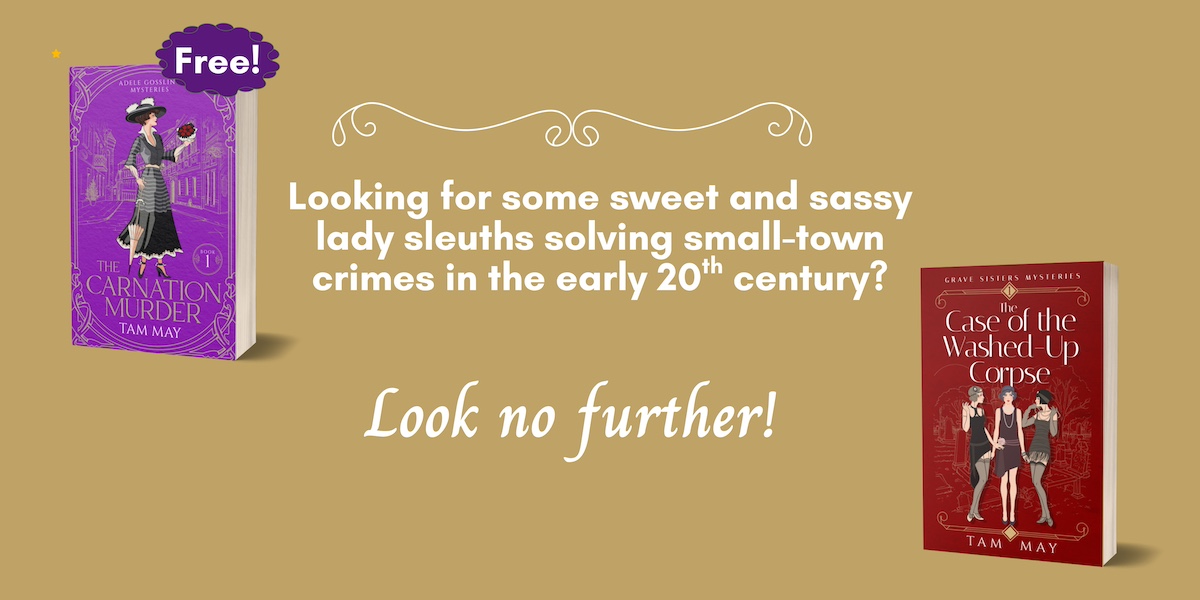
In my upcoming historical mystery series, The Paper Chase Mysteries, the series protagonist, Adele Gossling, also emerges as a New Woman. She’s the Gibson Girl in every way, including her unhesitating involvement in crime investigation. In the opening of the first book, Adele arrives at a small town still caught inside the net of Victorian ideals in an automobile. Anyone owning a car, let alone a woman, at that time when they were still considered passing fads, was seen as more of a nuisance than an innovator.

Adele soon establishes herself in town as an independent woman who owns her own home and runs a stationery store. She prefers to help the town sheriff and his deputy (her brother) solve crimes than participate in teas and socials that were the primary occupation for women who were unmarried.

If you’d like to read The Specter, you can find all the information for the book here. You can read more about the series here. To find out more about my historical mystery series, coming in 2021, you can check out this page.  

Want more fascinating information on history? Like social and psychological history and not just historical events and dates? Then sign up for my newsletter! Plus, you’ll get a free short story when you do :-). Here’s the link!

instagram
Facebooktwitterredditpinterestmail

DOUBLE COVER REVEAL!!! Waxwood Series Refresh + Dandelions Cover Reveal

Facebooktwitterredditpinterestmail

I have double whammy goodness for you this week!

I’ve been wanting to refresh the covers for my Waxwood Series for a while. While I love the idea of classic paintings on covers (I’m all about the classics), I also realize these paintings are a flashback into the past that many readers might not be attracted to. Many of us love to look at old paintings, but they don’t always speak to who we are or what we feel today, as individuals or as an era.

I think this is especially true in the past four or five years. There have been so much rushing forward and so many changes (some good, some not so good) we’re all looking ahead at life differently, and there is no going back. We can enjoy the past for what it was, but we also have to look toward the future.

With that said, here are the new covers for Books 1, 2, and 3 of the Waxwood Series.

historical fiction, series, Waxwood Series, 19th century, Gilded Age, family saga, family drama, women's fiction, coming-of-age

The Specter Photo Credit: 

The Specter Photo Credit: Portrait of Sonya Knips, Gustav Klimt, 1898, oil on canvas, Österreichische Galerie Belvedere, Vienna, Austria: Aavindraa/Wikimedia Commons /PD Old 100

False Fathers Photo Credit: Karl Joseph Burkmuller, Franz Xaver Winterhalter, 1830, oil on canvas, Miguelemejia/Wikimedia Commons/PD Art (PD old 100)

Pathfinding Women Photo Credit: Painting of three women in white, long-sleeved dresses, Charles Perugini, 1839-1918, oil on canvas: Needpix.com /CC0

I discovered these marvelous seascape paintings that give off the vibes (sometimes contradictory) of Waxwood as a place (and if you’d like to read more about the real seaside town that inspired Waxwood, you can read this blog post). 

The series has one last book coming out in December. It’s called Dandelions, and you can find out more about the book here. But for now, here’s the fourth and last cover for the series:

historical fiction, women's fiction, Waxwood Series, series, Gilded Age, 19th century, US history, family saga, family drama

Dandelions Photo Credit: Couple painting, Dionisios Kalivokas, 1858, canvas and oil, Corfu National Gallery, Greece: File upload bot (Magnus Manske)/Wikimedia Commons/PD Art (PD old 70)

Below are links where you can find out and purchase the first three books of the series:

The Specter (right now selling for 99¢)

False Fathers

Pathfinding Women

If you’d like to know more about the series itself, check out this page.

Want more fascinating information about history? Like social and psychological history and not just historical events and dates? Then sign up for my newsletter! Plus, you’ll get a free short story when you do :-). Here’s the link!

instagram
Facebooktwitterredditpinterestmail

Marriage Advice From the Turn of the Century

Facebooktwitterredditpinterestmail

Photo Credit: Portrait of a man and woman, possibly wedding photo of husband and wife, probably from around the 1890s, photographer unknown, Wakefield 1 High Street, Ealing: whatsthatpicture/Flickr/Public Domain Mark 1.0

If you’re a fan of my work, you know I’m not a romance writer, per se. I have nothing against historical romance, and I love classic romances like Jane Eyre, Wuthering Heights, and Jane Austin’s novels, but I’m just not in that vein.

However, my upcoming book, Pathfinding Women, does have a romantic subplot. And for this, I went searching for information on marriage and love in the Gilded Age. A very interesting article on the Click Americana website cropped up in my research titled “Tips for a happy marriage: Advice for newlyweds, from the 1900s“. It’s actually a series of articles published in the early 20th century by the San Francisco Examiner, so the advice given is actual “real time” suggestions for newlyweds. 

Needless to say, the marriage advice is about what I expected. Although the first few decades of the 20th century were somewhat more progressive than the prior century, there was still a lot of Victorian baggage left from the separate spheres when it came to relationships. The passage that interested me (there are a few included in the article) was written in 1901, just at the beginning of the new century. The advice begins with the obvious: “‘First select a MAN’” (Wheeler Wilcox, par 2). At first glance, this might seem like a “well, DUH” kind of thing. But I think it’s interesting to note Wheeler Wilcox uses the word “select”. Sadly, many women in the 19th century didn’t really chose a marriage partner — their circumstances often made marriage imperative, and they sometimes had to go with whatever was available. But the Gilded Age was the era of the New Woman, so women had choices, even in marriage partners. 

Also interestingly, Wheeler Wilcox was no fool when it came to the personality of the Gilded Age man. She warns women, “[o]f course, he will be more or less selfish. That is the way parents rear their sons to be” (par 3). Her solution to this problem is for the wife to show patience and tolerance, and teach him to be a considerate, kind human being by modeling that behavior.

Some of the advice is actually quite sound, though. For example, Wheeler Wilcox suggests that, when a husband chides a wife about one of her faults, she ought to remind him he has faults as well and enter into an agreement with him so that they can both work on themselves (“‘Let us enter into a Mutual Improvement Society. I want to be everything you admire — you want to be everything I admire. I will try and do my part and you must do yours’” (Wheeler Wilcox, par 6)). There is the assumption here that men and women are equal partners in a marriage and therefore, must compromise and work together to make the marriage a happy one. This wasn’t exactly the attitude the Victorians had toward marriage (as you’ll see later).

Unfortunately, Wheeler Wilcox’s advice sort of goes downhill from there. Wives are told to be prepared to make sacrifices, stroke the husband’s ego, and please him as much as she can. She should create a happy, harmonious home, always having the house clean and looking her best. Wheeler Wilcox even suggests bad behavior (including alcoholism and adultery) should be accepted as a given for some men:

“Of course, we must make allowances for the occasional lawless and drunken mariner who sends his ship on the rocks and the worthless husband who does not appreciate life’s best gifts. There are men whom no woman on God’s earth could keep loyal or honest; but they are exceptions” (par 15)

Nevertheless, the attitude toward marriage and especially a woman’s role in it has clearly shifted from the Victorian period. Although the woman is still expected to play her role as the angel in the house, she is also advised to voice her displeasures in the marriage and expect more of her husband in terms of love, affection, and respect. Such, sadly, was less the case a century before. In another article by Click Americana, we get a taste of pre-Civil War marriage advice. There is no assumption that the woman is equal to the man in marriage. She is the subservient and should always remain so, abiding by her husband’s law in the home, never contradicting him (heaven forbid!), and centering her world around him.

In Pathfinding Women, Vivian is in a thankfully more progressive state of mind than that. Though she’s not quite a New Woman, she has her own ideas about what she wants in marriage, some of which she expresses in a scene with Monte Leblanc, the love interest in the book, and in the company of a Miss Sowberry, who is quite young but has been taught all the virtues of Victorian womanhood by a rather domineering mother:

“There are times when women are a burden to men.” Vivian cast her eyes across a table with the silver-gilled carp. “Just as sometimes men are a burden to women.”

“You have modern opinions about marriage, then?” [Mr. Leblanc] asked.

“Some,” Vivian admitted. “I believe, like Mrs. [Lucy] Stone, that women should keep their maiden names after marriage, if they wish. That’s one reason why I went back to being Miss Alderdice when my husband died.”

“A girl ought to make a home for her husband, wherever it is,” said Miss Sowberry but she sounded as if her opinion were being dictated by someone else.

To read more about Pathfinding Women, which will be out on September 13, check out this webpage. And to learn more about the series, you can go here.     

Want more fascinating information about history? Like social and psychological history and not just historical events and dates? Then sign up for my newsletter! Plus, you’ll get a free short story when you do :-). Here’s the link!

Works Cited:

Wheeler Wilcox, Ella. “Love, sense, & patience: The 3 most important things for a happy marriage (1901).” From “Tips for a happy marriage: Advice for newlyweds, from the 1900s.” Click Americana. Synchronista, LLC, 2011-2020. Web. 29 July 2020.

instagram
Facebooktwitterredditpinterestmail

The Buccaneer in Nineteenth Century America

Facebooktwitterredditpinterestmail

Photo Credit: sdigitall/Depositphotos.com 

If you’ve read the first book of my Waxwood Series, The Specter, you might already be familiar with the term “buccaneer” as it pertains to the 19th century and to the Gilded Age in particular. Early in the book, there is gossip amongst the Nob Hill blue bloods about Malcolm Alderdice, the patriarch of the Alderdice family, and his rise in business and society:

“Oh, that poor Penelope, the woman was such a lamb!

“Too good for him for the likes of her father’s clerk, to be sure. Can’t think why she married him.”

“Oh, that’s obvious, my dear. Where there’s money to be had, rest assured, the buccaneer shall have it.”

“True, Catherine, true. And who can say how far the buccaneer will go to make himself one of us?”

So the buccaneer was a popular image in the 19th century Gilded Age, especially in the realms of the public sphere.

Ever since I started writing historical fiction, definitions and word origins fascinate me, and the word “buccaneer” is no exception. The Merriam-Webster dictionary defines the term as “any of the freebooters preying on Spanish ships and settlements especially in 17th century West Indies” (“Buccaneer”, n.d.). This is the way I think many of us picture the buccaneer — something off of a pirate ship, a bad guy who looks like Johnny Depp in the Pirates of the Caribbean film franchise.

But in the 19th century, the word took on the more figurative meaning that exists today in our modern world which the Merriam-Webster dictionary defines as “an unscrupulous adventurer especially in politics or business” (“Buccaneer”, n.d.). As I mentioned in my blog post about the Gilded Age here, the 19th century was a time when big businesses were built, millionaires were made, and corruption and graft abounded. It wasn’t just about spending money in an excessive, lavish way. It was also about making it — any way you could, whether it skirted the laws of fair trade or not.

In this atmosphere, the modern buccaneer was born. Ambitious, ruthless, and driven, the buccaneer was a wheeler-dealer whose only interest was getting ahead and making money. Thus, he often used unscrupulous business methods. Probably the most infamous of these in the 19th century were the Robber Barons. These were men like Andrew Carnegie, Andrew Mellon, and J.P. Morgan. In San Francisco, there were specifically four heavy hitters who made up the railroad Robber Barons: Leland Stanford, Mark Hopkins, Charles Crocker, and Collis P. Huntington. 

We do, however, want to consider that these men, while ruthless in business, also did some good works. Many had the “pay it forward” attitude, and some of America’s most impressive institutions and cultural centers were built from their initiative. For example, Leland Stanford served as governor of California and instituted forest conservation and, as a believer in education, oversaw what is now San Jose State University and, of course, founded Stanford University.

And, interestingly, the term began to acquire less negative connotations around the mid-20th century, at least in Britain. According to this article from the BBC, several powerful corporate businessmen saw the term as connoting qualities of daring, adventure, and innovation.

While Malcolm Alderdice is not on the scale of Stanford or Carnegie, San Franciso society is none too keen to accept him into the fold, and this is part of the Alderdice family struggle in the series. There’s also another buccaneer who appears in Book 3 of the series, Pathfinding Women. His name is Monte Leblanc, and he’s referred to by a minor character as “our cousin, the Canadian buccaneer”. His cousin (one of the San Francisco social matrons) insists he made his fortune “without ruffling any feathers”. Whether that’s true or not remains a question in the novel.

You can read more about Pathfinding Women, which will be out next month, here. You can also learn about Malcolm Alderdice and his buccaneering ways in Book 1 of the series, The Specter, which is currently on sale for 99¢. And if you want to know more about the series in general, including Book 4, which will be coming out at the end of 2020, you can go here.      

Want more fascinating information about history? Like social and psychological history and not just historical events and dates? Then sign up for my newsletter! Plus, you’ll get a free short story when you do :-). Here’s the link!

Works Cited:

Buccaneer. (n.d.). In Merriam-Webster.com dictionary. Retrieved from https://www.merriam-webster.com/dictionary/buccaneer.

instagram
Facebooktwitterredditpinterestmail

The History of Father’s Day in the United States

Facebooktwitterredditpinterestmail

Photo Credit: Story Time (Portrait Of The Artist`s Father And Daughter), Ekvall Knut, 1843-1912, taken 11 April 2013 by Plum leaves: Plum leaves/Flickr/CC BY 2.0

Last month, I wrote a blog post about the history of Mother’s Day. In honor of Father’s Day, which this year will be on Sunday, June 21 in the United States, I’m taking a look back at the history of Father’s Day too.

Unlike Mother’s Day, which has definite origins, the history of Father’s Day is a little more vague. There were, in fact, two local celebrations going on during the Progressive Era that are thought to be the official kick-off of Father’s Day, both celebrated for personal reasons. In 1910, Sonora Smart Dodd, inspired by Mother’s Day, which was becoming a popular holiday at that time, campaigned in her home state of Washington for an official Father’s Day celebration in June, largely wanting to commemorate her own father, who had been a Civil War veteran and raised her and her five brothers and sisters alone on a farm when his wife died in childbirth. She succeeded, as Washington began celebrating a state-wide Father’s Day that year. The other celebration happened on a wider but no less personal scale. Two years earlier, in West Virginia, a local Methodist church in Fairmont celebrated the day in honor of 361 fathers who were killed in a local mining explosion.

But as far as official lobbying and support goes, this was slow in coming. There were national political figures, such as William Jennings Bryan and Calvin Coolidge who supported a national Father’s Day, but these recommendations didn’t get much traction. There are several reasons for this. As many of us know, Mother’s Day has becomes a commercially viable holiday and was that way from very early on. It was, in fact, its commercial appeal that helped get Woodrow Wilson to sign a proclamation declaring it a national holiday in the United States in 1914. But many felt that fathers just didn’t have the same monetary appeal as mothers, mainly because the sentiment attached to mothers from the long history of the separate spheres wasn’t attached to fathers. As I discuss here, the role of the father in the 19th and early 20th century was more of a teacher and disciplinarian. The same sentimentality also seemed to undermine the idea of the “manly man”, emphasizing the masculinity crisis, especially in the late 19th and early20th centuries. 

There were even some int he 1920’s and 1930’s who lobbied to abolish Mother’s Day and, instead, create an overarching Parent’s Day, arguing that it wasn’t the separate role of the mother, or the father, for that matter, that should be celebrated — it was the institution of parenthood that deserved the celebration (and my home country, Israel, went a step further and abolished Mother’s Day and Father’s Day in the 1990’s in favor of Family Day). But the lobbying for a Father’s Day was strong and in 1972, Richard Nixon declared Father’s Day a national holiday on the third Sunday of June in the United States.

Fathers play a role in my Waxwood Series, though in a less conventional way than in most books. In False Fathers, Book 2 of the series, Jake Alderdice’s biological father is absent and, instead, his entire life had been filled with substitute father figures. It’s one of these figures that leads him to both chaos and maturity in the book.

Want to grab a copy of the book for Father’s Day? False Fathers is at a special price through Sunday. You can find out more about it and buy it at your favorite online retailer here. To find out more about the series, you can go here.    

instagram
Facebooktwitterredditpinterestmail