Disassociative Feminism: Present and Past

Facebooktwitterredditpinterestmail

Recently, a very talented writer friend of mine wrote an article about disassociative feminism that really gave me food for thought. You can read the article here.

Disassociative feminism, according not just to my friend’s article but several others, is a phenomenon that has taken over the younger generation of women, especially in post-COVID times. Disassociation is a psychological term that refers to the emotional distancing many people experience as one way of coping with past trauma. It’s like your body and mind are numb so you can soldier on through life without being destroyed by the pain and turmoil of past traumatic experiences.

As I understand it, disassociative feminism is about numbing emotionally to the struggles women are still facing and succumbing to the spirit of the “ideal feminine”. It’s essentially about younger women rejecting the fight for women’s rights in favor of a more recognizable image of women’s roles as dictated by the separate spheres

There’s some truth in this. I recently posted some new covers my designer created for my post-WWII short story collection Lessons From My Mother’s Life, which I’m rebranding next year, and in the comments, someone mentioned there is now a movement among some women of the younger generation to embrace the homemaking ideals of the Occupation: Housewife era (which, I might add, second-wave feminists worked very hard to break down).

There’s no denying articles like my friend’s are very important to help us sound the alarm regarding the ennui many younger women have fallen into when it comes to feminism. But I also see the times we’re living in as a reflection of the past, which might shed a different light on what’s happening in the 21st century.

We need to keep in mind that this kind of exhaustion and numbness regarding feminism has occurred throughout history. Feminist gains have come in waves ever since the first suffragists in the mid-19th century (which is one reason why we refer to them as first-wave, second-wave, and third-wave feminism). Back then, women were fighting for a much more basic right: the right to vote. In America, women achieved this in 1920 with the passing of the 19th Amendment. And then what happened?

Not surprisingly the younger generation in the 1920s were in a similar position of disassociativeness that women in the 21st century are today. I’ve been reading up on the 1920s flapper in preparation for a new series I’ll be working on next year, and I was surprised to learn the harshest critics against the flappers were these late 19th and early 20th century feminists who had just won women the vote. They didn’t consider flappers as practicing what they were preaching. In fact, with the flappers’ man-crazy attitudes and their sexually liberating behaviors, they saw them as digressing back to an earlier time before the suffragists’ fight for women to be accepted as equals.

The 1930s continued this wave of feminist ennui. There was the Great Depression in America to contend with where most people, women and men, were just trying to survive, and not many had the strength to take up a political cause. Then World War II hit and although women weren’t out marching in the streets, they gained some momentum back when many took up working outside the home and helping the war effort.

The post-World War II era brought, as mentioned above, the Occupation: Housewife era which Betty Friedan talks a lot about in her book The Feminine Mystique. Women were basically encouraged (if you want to call it that) by the media and medical establishment to retreat back to the home and fulfill their “destiny” as wives and mothers. I’ve mentioned in several blog posts (like this one which I wrote on my old blog in 2017) how the 1950s and early 1960s produced the idea that a woman could have either a family or a career but not both. Many women bought into this and shied away from making use of their higher education in favor of marriage and children, not considering they could balance both. So again, we had a step back into the past.

As many of us know, though, the wave went up in the late 1960s when the second-wave feminists took up the fight again in the wake of the disillusionment many women were feeling from the Occupation: Housewife era. The early 80s saw a lull with the feminist cause but the early 90s brought third-wave feminism which took into account a much broader spectrum of women’s rights by embracing global feminism.

Perhaps the best evidence that feminism isn’t lost in the 21st century. A group of young women posing with a banner proclaiming “Fourth Wave,” hinting that we might be seeing the fourth wave feminists starting to take up the fight for women’s rights.

Photo Credit: Young women posing with a banner on International Women’s Day in London in 2017. Taken by Gary Knight on 8 March 2017: Davey2010/Wikimedia Commons/CC BY 2.0 

Although many consider the fight for women’s rights in danger in the 21st century, I look at it differently. Consider that COVID-19 had a global impact on all of us, and we’re still feeling the post-traumatic effects of it. In the wake of this global pandemic, it’s perhaps no surprise we’re seeing this disassociative feminism rise up in many younger women. But that doesn’t mean they’ve given up the fight. I see many younger women practicing what older feminists preached decades, even centuries ago. I was recently talking to a friend of mine whose daughter (of the younger generation) protested against the attitudes men showed toward women in her community. Her objections touched on the kind of protests against sexual objectification and harassment that second-wave feminists fought for sixty years ago. I’m not here to offer solutions, but I do think the point Jacqueline Delibas makes in her article about opening up the conversation about feminism and women’s rights and making sure we are including all communities (such as the transgendered community) is a step in the right direction.

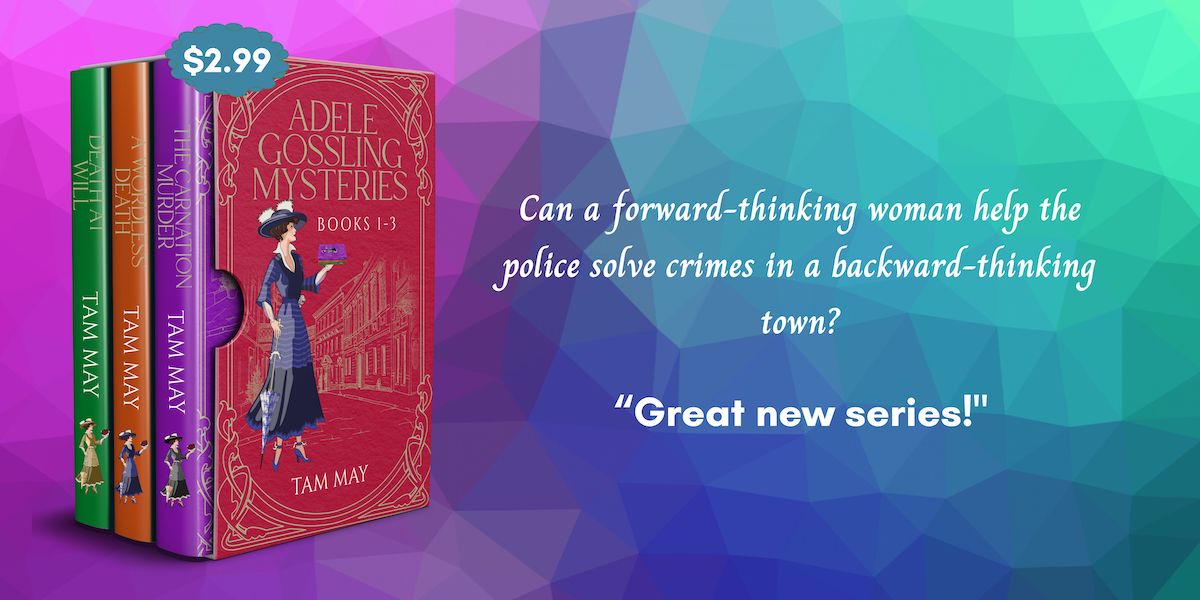
If this blog post interests you, you might want to not only check out Jacqueline’s article linked above but also my post-WWII short story collection Lessons From My Mother’s Life which you can find here. And if you’re looking for a series that does feature a young woman who is all about the spirit of suffragism, you can’t do better than my Adele Gossling Mysteries. Book 1 is free on all booksellers and Book 6 is coming out in August!

If you love fun, engaging mysteries set in the past, you’ll enjoy The Missing Ruby Necklace! It’s available exclusively to newsletter subscribers here. By signing up, you’ll also get news about upcoming releases, fun facts about women’s history, classic true-crime tidbits, and more!

instagram
Facebooktwitterredditpinterestmail

Go West, Young Man, Go West

Facebooktwitterredditpinterestmail

Today, July 13, is one of those funky holiday days. It’s Go West Day. 

This term actually came from an editorial piece written by Horace Greenly. Greenly was a well-known figure in the mid-19th century, as he was the editor and publisher of the New York Tribune and even ran for presidential candidate against Ulysses S. Grant in 1872. So Greenly was considered a voice of authority at that time. On this day in 1865, faced with a recently ended Civil War which left many soldiers destitute, he advised them to leave their hometowns for brighter horizons in the Midwest and West which had, a few years earlier, opened up with the Homestead Act. 

It’s no wonder Greenly’s words “Go West, young man, go West” resonated with so many Americans in the post-Civil War era. The West was seen not only as virgin territory to settle and explore (which would appeal to many young Civil War veterans looking for adventure) but also as a place to start a new life. The Homestead Act gave the option of acquiring acres of land for a small fee, though once the settlers reached that land, they were on their own in terms of paying for the necessary tools and equipment it took to work that land. Still, for a young man just starting out in life with no money and no assets, it wasn’t a bad deal.

Photo Credit: Painting of a small town where the train and wagons are heading West, print, 1868, Currier & Ives: Library of Congress website/Public domain

There’s no doubt that “Go West, young man” also appealed to others for darker reasons. If a man or woman wanted to escape dire circumstances, they could do no better than to “go West”. Criminals who committed a crime in one state might go West to escape punishment, as even though the constitution demanded states extradite a fugitive to the state in which the fugitive committed the crime, whether this was done was up to the governor’s discretion. 

Similarly, someone seeking to escape a non-criminal but uncomfortable situation was attracted to the idea of “going West”. In the 1949 film version of Henry James’ novella Washington Square (1880), when Morris (Montgomery Clift) discovers Catherine (Olivia de Havilland) is disinheriting herself in order to run away and elope with him, he promises to return to take her away, then goes home, packs his bags, and hops on a boat to California. In other words, to avoid marrying a woman he only intended to marry for the inheritance she would get, he flees West. 

Although the protagonist for my Adele Gossling Mysteries has, in a sense, already “gone West” (she was born and raised in San Francisco), she nonetheless follows the “go West” call when she decides to leave the big city for the small town of Arrojo, California in order to find peace and small pleasures. Considering her constant involvement in crime-solving, peace and small pleasures aren’t exactly what she gets!

Book 6 of the Adele Gossling Mysteries is coming soon! You can already pick up a copy of it at a special preorder price here. And don’t forget that Book 1 of the series is always free!

If you love fun, engaging mysteries set in the past, you’ll enjoy The Missing Ruby Necklace! It’s available exclusively to newsletter subscribers here. By signing up, you’ll also get news about upcoming releases, fun facts about women’s history, classic true-crime tidbits, and more!

instagram
Facebooktwitterredditpinterestmail

The Vague Origins of Father’s Day

Facebooktwitterredditpinterestmail

Today is Father’s Day in the United States. If Father’s Day sometimes seems like an afterthought, it sort of was, though not because fathers aren’t worthy of honor. I trace this back to the residue of the 19th century separate spheres where home and family brought up images of mothers more than fathers. So we can understand in this light why Mother’s Day gets a lot of attention.

Unlike Mother’s Day, which has definite origins, the history of Father’s Day is a little uncertain. There were, in fact, two local celebrations going on during the Progressive Era that is thought to be the official kick-off of Father’s Day, both celebrated for personal reasons. In 1910, Sonora Smart Dodd campaigned in her home state of Washington for an official Father’s Day celebration in June, mainly wanting to commemorate her own father. Dodd’s father had been a Civil War veteran and raised her and her five brothers and sisters alone on a farm when his wife died in childbirth. She succeeded, as Washington began celebrating a state-wide Father’s Day that year. The other celebration happened two years earlier, in West Virginia when a local Methodist church in Fairmont celebrated the day in honor of 361 fathers who had been killed in a local mining explosion.

But official lobbying and support were slow in coming. National political figures such as William Jennings Bryan and Calvin Coolidge supported a national Father’s Day, but it didn’t get much traction. Lobbying for a Father’s Day continued, and in 1972, Richard Nixon declared Father’s Day a national holiday on the third Sunday of June in the United States.

Why was Father’s Day almost an afterthought? As they say, follow the money. Mother’s Day was a commercially viable holiday from very early on. It was, in fact, its commercial appeal that helped get Woodrow Wilson to sign a proclamation declaring it a national holiday in the United States in 1914. But many felt fathers just didn’t have the same monetary appeal. As I discuss here, the role of the father in the 19th and early 20th centuries was more of a disciplinarian. The sentimentality given to mothers seemed to undermine the idea of the “manly man”, emphasizing the masculinity crisis of the Gilded Age. 

Talk about famous fathers! This photo is of none other than Sir Arthur Conan Doyle, the creator of Sherlock Holmes, and his three kids. He doesn’t look much like a disciplinarian dad here, does he?

Photo Credit: Sir Arthur Conan Doyle and his three children, 1900, Bain News Service, publisher, Library of Congress: Picryl/No known restrictions

Fathers are just as complex as mothers (something I discuss in my blog post about Mother’s Day) and Adele’s father is no exception. Although deceased when the series opens, Otis Gossling still profoundly influences his daughter and his son, Adele’s brother, Jackson, but in very different ways. As a highly-revered San Francisco criminal lawyer, it was his position that gave them their well-to-do standing. But Adele sees him very differently than her brother Jackson. Who is right and who is wrong? You’ll have to read the Adele Gosslng Mysteries to find out! 

And you can start right here with Book 1, The Carnation Murder, which is free on all bookstore platforms. Book 6 is coming out later this summer, so check that out here

If you love fun, engaging mysteries set in the past, you’ll enjoy my novella The Missing Ruby Necklace! It’s available exclusively to my newsletter subscribers and you can get it here. By signing up, you’ll also get news about upcoming releases, fun facts about women’s history, classic true-crime tidbits, and more!

instagram
Facebooktwitterredditpinterestmail

Why My Waxwood Series is Also a Mystery

Facebooktwitterredditpinterestmail

One of the beautiful things about being an author is touching the lives of readers with your stories. I cherish readers who respond to my emails with enthusiasm for the next book (one lovely reader already emailed me asking if I still need Advanced Review Copy reviewers for Book 6 of my Adele Gossling Mysteries when the book won’t be out until August and I haven’t even put out a call for ARC readers!) I also love it when readers discover elements in my stories that never occurred to me when I was writing them.

This is exactly what happened with the Waxwood Series. When I wrote the books, I was thinking of a series arc involving historical coming-of-age, specifically one woman’s journey into the past and her maturing into adulthood in one of the most turbulent and chaotic times in American history. 

But one reviewer surprised me by calling the Waxwood Series “a mystery saga of the Gilded Age.” At the time I wrote the series, I wasn’t writing mystery fiction or even contemplating publishing a mystery series. I had written Book 1 of the Adele Gossling Mysteries as more of an experiment during National Novel Writing Month back in 2013 but put it aside to concentrate on historical fiction. So the idea that the Waxwood Series was also a mystery saga came as a complete surprise to me.

But now some years have passed since the last book of that series was published. I can now look back and see the gold nugget my reader discovered is absolutely true.

Now, it’s not a mystery in the traditional sense. It has no detective, no amateur sleuth, no whodunit, and no red herrings. The mystery is largely personal and psychological. In Book 1, Vivian is confronted by a woman who knew her grandmother, Penelope Alderdice, in her youth and the woman she knew was not the woman Vivian grew up with. As a debutante coming into adulthood, Vivian considers it vital to know the truth about her family’s past. So her search takes her through several “clues” (such as Penelope’s summer in Waxwood, the name Grace, and letters Penelope wrote home about that summer) which tell her more about who Penelope was and what she sacrificed to become a shipping tycoon’s wife and Nob Hill socialite in the mid-19th century. The clues also point toward some astonishing truths about Vivian’s family that she never knew. Like a detective, she confronts her mother about these truths (the evidence) and gets some answers — but not all of them.

Book 3 continues Vivian’s sleuthing when a man who was acquainted with Penelope through stories from his aunt drops clues about Penelope that lead Vivian to realize there are still some skeletons in the closet she needs to air out. In spite of her promise to her mother to focus on winning the heart of a wealthy Canadian who can bring them back into the good graces of Nob Hill society, Vivian can’t resist pursuing these clues to unravel the mystery behind her family’s past. Her search takes her to a deserted artist’s colony in the hills and the bowels of San Francisco’s poorest neighborhood to find out about her roots. The results are life-changing for her. 

Book 2 focuses on Jake, Vivian’s brother, whose journey is more about his coming-of-age as a man in the Gilded Age. Book 4 presents an even greater mystery for Vivian — the man responsible for her family’s fall from grace comes back into her life unable to speak or communicate. In spite of her loathing for him, she gets involved with unraveling the clues behind his silence and faces the last of her family demons. 

Not all mysteries are about finding an external killer. There are crimes of the past that sometimes need to be put to rest before people can move on with their lives, just as finding justice for the murder victim and his or her family allows those involved to move on.

I would love for you to start reading the Waxwood Series right now and you can do that for free with Book 1, The Specter. Vivian’s story continues in Book 3, which is now on sale so you can find out about that here

*The Waxwood Series is a stand-alone series. That means you do not have to have read all the books in order to enjoy or understand each book.

If you love fun, engaging mysteries set in the past, you’ll enjoy The Missing Ruby Necklace! It’s available exclusively to newsletter subscribers here. By signing up, you’ll also get news about upcoming releases, fun facts about women’s history, classic true-crime tidbits, and more!

instagram
Facebooktwitterredditpinterestmail

The Marriage Age in the 19th Century

Facebooktwitterredditpinterestmail

In the 19th, and even the early 20th centuries, age was an important factor for both men and women when it came to marriage. This is especially true of women. Pretty much any woman who didn’t get married early was sneered at behind closed doors as being well on her way to spinsterhood (which, today, isn’t stigmatized like it was then). 

In the 21st century, many choose to marry at a later age. I can see several reasons for this. Both women and men are generally established in their careers later in life, so they choose to marry and have a family once they feel they’ve “gotten it together”. Many women prefer to start their careers before they take on marriage and motherhood. There is also a level of emotional maturity and intelligence that comes with age that (we hope) makes relationships and child-rearing more fulfilling. And there is no denying the pandemic and economic downturn in the last three years has something to do with people waiting a little longer to get married.

marriage, 19th century, gilded age, Waxwood Series, women, men

Young married couples in the 19th century knew marriage wasn’t all hearts and flowers. They were practical as well. I’m guessing this is probably an advertisement for Domestic sewing machines.

Photo Credit: Bride & Groom: Karen Arnold/PublicDomainPictures/CC0 1.0

This is in stark contrast to the marriage age in the 19th century. The average age for women to marry was, roughly, 20, while for men, it was 26. Why were women marrying at such a young age? We want to remember women were not as autonomous as they are today. Due to the separate spheres, many women were dependent on others for their livelihood, and marriage was the primary way they could survive when they came of age. There was also the “cult of True Womanhood” mentality where women’s destinies were to be wives and mothers, so marriage was seen as their goal in life. This is even true in the early 20th century when the New Woman. Keep in mind that, as independent and career-oriented as the New Woman was, she was still positioned as offering no threat to the “cult of True Womanhood” in her ultimate purpose in life (marriage and children).

Surprisingly, upper class women took the marriage age more seriously than middle and lower class women. You would think women with social and economic privileges would be more independent than their less privileged sisters, but, in reality, family and social expectations lay heavily upon them (a theme that comes back again and again in my Waxwood Series). Women who expected to marry into high society and/or maintain their position among the blue bloods had to marry young. In her book What Would Mrs. Astor Do? author Cecelia Tichi describes actress and model Evelyn Nesbitt, whose decision to marry the rich but abusive Harry Kendall Thaw came largely from the fact that she was “now over twenty years old, a perilous age for a Gilded Age starlet harboring hopes of matrimony” (location 3210). How much over twenty years? According to Tichi’s book, when Nesbit married Thaw, she was 21 years old.

In Pathfinding Women, the social standing of both Vivian and her mother Larissa hinges on Vivian marrying again. Vivian and her mother and, in fact, the Washington Street blue bloods that make up their social set are hyper-aware of this fact:

Vivian thought with irony of the past few days. “Yes, it would certainly be peaceful for us both if I were to become Mrs. Monte Leblanc.”

“And just what you need at this particular time in your life.”

A pain shot through Vivian. “What do you mean, Mother?”

“You always accuse me of ignoring the truth,” said Larissa. “But you don’t like it when someone else shows you the truth you’ve been ignoring.”

Vivian turned up the gas lamp on the night table and observed her mother’s face illuminated by a yellow halo. “You’ve always been shrewd, haven’t you, Mother?”

“I’m trying to make you see!”

“See what? That I’m not getting any younger?” Vivian’s eyebrows arched. “That’s what you meant, isn’t it? You think I ought to grab the first man that asks me like Cousin Emma did.”

“I wouldn’t go so far as that.” Her mother’s voice was reasonable. “But twenty-six is an age where a woman can begin to expect little out of life if she’s not married.”

You make twenty-six sound like ninety-six,” said Vivian, realizing she was starting to sulk.

Vivian is considered, by the standards of the 19th century, to be well above the marriage age, though she is still young, and this puts her in an awkward position matrimonially, and one that her love interest, Monte, who is considerably older than she is, doesn’t fail to grasp and use to his advantage.

Pathfinding Women, the third book of the Waxwood Series, is at a very special price right now. Find out about the book here. And don’t forget that Book 1, The Specter, is free here 

If you love fun, engaging mysteries set in the past, you’ll enjoy my novella The Missing Ruby Necklace! It’s available exclusively to my newsletter subscribers and you can get it here. By signing up, you’ll also get news about upcoming releases, fun facts about women’s history, classic true-crime tidbits, and more!

Works Cited:

Tichi, Cecelia. What Would Mrs. Astor Do? The Essential Guide to the Manners and Mores of the Gilded Age. Washington Mews Books, New York University Press, 2018. Kindle digital file.

instagram
Facebooktwitterredditpinterestmail