Release Day Blitz for Adele Gossling Mysteries Box Set: Books 1-3!

Facebooktwitterredditpinterestmail

Title: Adele Gossling Mysteries Box Set 1: Books 1-3 (Adele Gossling Mysteries Box 

Series: Adele Gossling Mysteries

Author: Tam May

Genres: Historical Cozy Mystery

Release Date: November 25, 2023

Can a forward-thinking woman help the police solve crimes in a backward-thinking town?

“Great new series!”

Smart, inquisitive, and a firm believer in Progressive Era reforms, Adele Gossling seeks a new life after the devastating death of her father. She flees San Francisco for the town of Arrojo, planning a life of peace and small pleasures. But both elude her when she and her spiritual sidekick, Nin Branch, get involved in helping the local police solve the case of a dead debutante, a poisoned schoolteacher, and a family matriarch who may or may not have left a generous will.

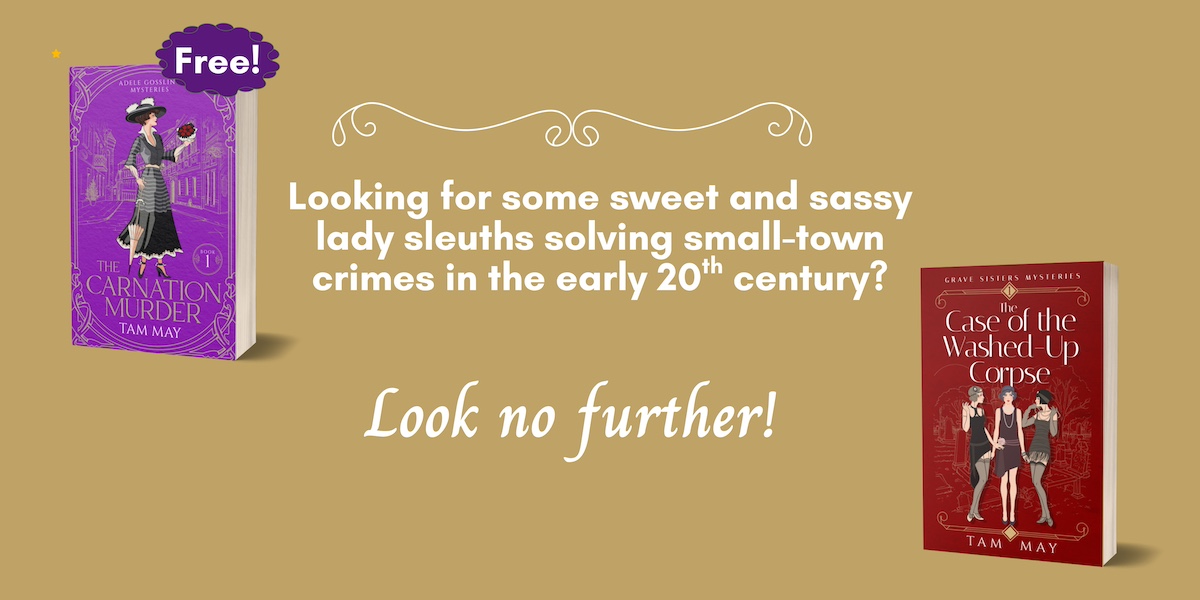
The Carnation Murder: Adele Gossling has barely been in Arrojo for a week when she discovers her neighbor’s dead body in her gazebo. Can Adele and Nin solve this puzzling case involving a striped carnation, a diamond ring, a note, a muddy pair of boots, and a broken promise?

A Wordless Death: Millie Gibb, the new teacher at the local girl’s school, is found dead and everybody in town assumes the homely, unmarried spinster committed suicide. Can Adele and her clairvoyant friend Nin prove Millie’s death was foul play based on a cigar stub, a letter fragment, and a cigarette lighter before the case is closed for good?

Death at Will: When the affluent Thea Marsh dies unexpectedly, the trail of suspects leads to Thea’s beloved and favored eldest son, Theo. Will Adele make a case against Theo’s guilt for the police out of a stained teacup, a fountain pen nib, ashes that should have been in the fireplace, and daisies that should have been fresh?

Pick up this box set of the first three Adele Gossling Mysteries and immerse yourself in turn-of-the-century Northern California in all its dynamic and chaotic glory for a fun and cozy read!

You can get your copy of this box set at a special price at the following online retailers.


About the Author

Writing has been Tam May’s voice since the age of fourteen. She writes stories set in the past that feature sassy and sensitive women characters. Tam is the author of the Adele Gossling Mysteries which take place in the early 20th century and features suffragist and epistolary expert Adele Gossling whose talent for solving crimes doesn’t sit well with the town’s more conventional ideas about women’s place. She has also written historical fiction about women breaking loose from the social and psychological expectations of their era. Although Tam left her heart in San Francisco, she lives in the Midwest because it’s cheaper. When she’s not writing, she’s devouring everything classic (books, films, art, music) and concocting yummy plant-based dishes.


Social Media Links

Facebook: https://www.facebook.com/tammayauthor/

Instragram: https://www.instagram.com/tammayauthor/

Pinterest: https://www.pinterest.com/tammayauthor/ 

Amazon Author Page: https://www.amazon.com/Tam-May/e/B01N7BQZ9Y/ 

BookBub Author Page: https://www.bookbub.com/authors/tam-may

Goodreads Author Page: https://www.goodreads.com/author/show/16111197.Tam_May

instagram
Facebooktwitterredditpinterestmail

Death Outside the Battlefield: Lida Beecher

Facebooktwitterredditpinterestmail

Last month, I posted a tribute to World War I veterans. The war made people realize death can come too easily in the 20th century. However, not all deaths in 1914 took place on the battlefield. Some, in fact, happened in the backwoods of America and were just as shocking as those happening in Europe. 

Book 2 of the Adele Gossling Mysteries is about the death of a schoolteacher. During my research, I stumbled upon the case of Lida Beecher which both horrified and intrigued me. I wasn’t the only one. Residents of Herkimer County, New York where the murder took place were so devastated by the crime that a history of the area written in the 1970s completely excludes any mention of it. 

The story involves many complex players. To begin, the victim is Lida Beecher, a young and lovely schoolteacher whose eagerness to help her students usurped her experience in dealing with the troubled ones. Then there is the perpetrator: Jean Gianini, a sixteen-year-old from a very unstable family environment that included alcoholism, mental disabilities, and physical abuse. Gianini lured Beecher into the woods, hit her with a monkey wrench, and then stabbed her to death, hiding her body in the brush. 

The case exemplifies the limitations of education and medicine in the early 20th century. Schools at this time, especially in rural towns, were a one-room affair (think: Little House on the Prairie). Students of all ages attended and the teacher had to accommodate different learning levels, from the six-year-olds to the fifteen and sixteen-year-olds. Teachers were then, as they are now, grossly underpaid and they were also undertrained, especially in dealing with special needs children or children with disabilities. 

Photo Credit: Herkimer County Courthouse where the trail of Lida Beecher’s murder took place, Herkimer, NY, 19 September 2009, taken by Doug Kerr: Pubdog/Wikimedia Commons/ CC BY SA 2.0

All the sources on the case agree Gianini was both intellectually and mentally below average. During the trial, he went through several intelligence tests, including the Binet Test, which was used at the time to assess the mental age of children, and he was found to have the intellectual capacity of a ten-year-old even though he was sixteen. He also showed signs of mental disabilities. Some have said if Gianini were examined today, he would probably be diagnosed on the autism spectrum. Accounts of his time at school clearly showed neither his teachers nor the principal were equipped to understand or help him. Beecher tried but when he misbehaved, she called in the principal, who resorted to the same kind of humiliation and violence Gianini experienced at home. This set off feelings of resentment in Gianini and vows of revenge and, indeed, he gave his reason for killing Beecher as vengeance. 

The case set the precedence for the insanity plea, which became almost overused in the early 20th century. The defense was able to convince a jury that Gianini didn’t know what he was doing and get him committed to an institution rather than suffer the death penalty.

Teachers don’t fare well in Book 2 of my Adele Gossling Mysteries, A Wordless Death, either. The book is part of my 3-book box set, which includes Book 1 (The Carnation Murder) and Book 3 (Death at Will) is on preorder right now. So to get 3 books at a great price, check out this link

instagram
Facebooktwitterredditpinterestmail

The Spanish Lady and the Mexican Spitfire: Hispanic Heritage Month

Facebooktwitterredditpinterestmail

Today is the first day of Hispanic Heritage Month and cause for celebration! 

I’ve been watching a lot of silent films from the 1920s lately as research for a new historical cozy mystery series I’ll be working on next year and launching in 2025 (keep an eye out for more on that in the future). I’ve found classic films to be one of the best means of getting a sense of the atmosphere and everyday life from those eras.

I was pleased to find that Hispanic actors and actresses did exist during this early Hollywood era. Even more interesting, two Hispanic women dominated the screen during the 1920s and early 1930s, presenting two very different, and sometimes controversial, images of Latina women during this time. 

Photo Credit: Dolores Del Rio, 1927, gelatin silver print, National Portrait Gallery, Smithsonian Institute: Intellectualpropri/Wikimedia Commons/CC-Zero (public domain)

Photo Credit: Lupe Velez in Sailors Beware, 1927: Mahar27777/Wikimedia Commons/PD US expired

Dolores Del Rio came from Mexican aristocracy and was dubbed “The Spanish Lady” in the press. Her roles in this early period of Hollywood often centered around dignified and refined ladies of Hispanic origin. She blended the acceptable behavior of elegant women with a touch of exoticism that audiences loved. But during the 1940s, her roles grew more stereotypical and it was harder for her to control her scripts and how her Latina characters were portrayed. She abandoned Hollywood and went back to Mexico and became a very successful film star in the Mexican cinema.

Lupe Velez was completely the opposite. Nicknamed “The Mexican Spitfire,” she wasn’t afraid to present herself as the hot and sexy Latina lady who said what she felt, shrugged off conventions, and even yelled and screamed when the situation called for it, both on screen and off. Audiences loved her vivacious and high-spirited personality and her Mexican Spitfire comedies were a big hit with audiences. Her life ended tragically in the mid-1940s when rejected by her fiance, she took her own life.

Today many critics dismiss Del Rio as having played into the hands of white producers and directors in an Anglo version of “the Spanish lady” and Velez for having played the stereotype of the uncontrollable Mexican woman. But it’s important to remember that in the 1920s and 1930s, the Hispanic community was very much isolated and ostracized. For Hispanic women especially, there were few opportunities to see themselves represented by Hispanic actresses. Dolores Del Rio and Lupe Velez gave voice to the existence of the Latina-American woman not only in film but in real life. 

If you love fun, engaging mysteries set in the past, you’ll enjoy The Missing Ruby Necklace! It’s available exclusively to newsletter subscribers here. By signing up, you’ll also get news about upcoming releases, fun facts about women’s history, classic true-crime tidbits, and more!

instagram
Facebooktwitterredditpinterestmail

The Wage Gap: Is This Still a Thing?

Facebooktwitterredditpinterestmail

Today is Labor Day in America, which means we’re celebrating the working woman and man. Women indeed have a lot to celebrate on this day. Working conditions for women have improved dramatically since the early 20th century, and job opportunities for women have expanded considerably. Many workplaces recognize situations related to women that made it difficult for them to work in the past and accommodate these (such as maternity leave and daycare). And sexual harassment in the workplace has largely been addressed.

But one thing we can’t celebrate is the wage gap. That is, women are still not being paid equally to men on average for the same or similar jobs. 

Photo Credit: Dolly Parton, Lily Tomlin, and Jane Fonda, Washington D.C. Kennedy Center, taken 21 August 2019: Edithian/Wikimedia Commons/CC BY SA 2.0

One of my favorite scenes in the classic comedy 9 to 5 is the closing (spoiler alert if you haven’t seen the film). As the three office workers (Jane Fonda, Lily Tomlin, and Dolly Parton) are going around with the head of the company, showing him all the positive changes they’ve made (like flex time and in-house daycare), the head tells their boss (Dabney Coleman) that the one change he doesn’t approve of is paying women in the company the same as the men. As the credits close and the women are toasting their success, they recognize the wage gap is still an issue. I love this scene because even though by 1980, the second-wave women’s movement had lost a lot of its earlier steam, partly because many women believed they had won the fight, it’s a reminder that the fight was (and is – see this blog post) on.

The wage gap has existed for centuries. In the Victorian era, when fewer women were in the workforce and few had careers, women were often paid half or less what men were paid. The reasons for this were, according to employers, practical. According to the separate spheres, men were the bread winners and expected to support their families so they needed more money (a point Coleman makes to Tomlin in 9 to 5 when he tries to justify his reasons for giving a promotion she’s been wanting to a less capable male colleague). Women were at that time not expected to work for long, since their true calling (per the separate spheres) was marriage and motherhood. Employers didn’t want to pay full wages to workers whom they viewed as temporary (even if they weren’t). In addition, women’s work was undervalued because they were seen as “the weaker sex”. The jobs they performed were limited to what employers thought they could do for the most part (read: boring, repetitive tasks, such as in the factories) and therefore, valued less than men’s.

There was one period in American history where women earned more or less the same as men: World War I. During the First World War, when men were scarce and workers were needed for the war effort, government officials agreed to pay women the same as men to entice them into the offices and factories, and many non-government employers followed suit. Sadly, this didn’t stick, not even during World War II when employers again needed women workers (women got paid about forty percent of what men earned during the Second World War).

Just like the ladies of 9 to 5, we’re still fighting the wage gap in the 21st century. Mid-20th century women were receiving a little more than half the wages of men on average, and that number remained pretty steady after the war. It’s only increased to about eight-three percent, according to a study done in 2020. So we’re getting closer but we’re not there yet.

I believe in the working woman, which is why there are a lot of them in my Adele Gossling Mysteries. There are a number of women entrepreneurs (including Adele herself), but there are also women working for employers (such as the young ladies rooming at Mrs. Taylor’s boarding house, whom readers meet in Book 2). The victim in my new release, The Case of the Dead Domestic is, as the title implies, a maid working for a wealthy family when she gets killed. You can check out this sixth book of the series here

As for the practices of Labor Day in the early 20th century, you can experience what that was like in Book 4 of the series, which takes place on the holiday in 1904!

If you love fun, engaging mysteries set in the past, sign up for my newsletter to receive a free book, plus news about upcoming releases, fun facts about women’s history and mystery, and more freebies! You can sign up here

instagram
Facebooktwitterredditpinterestmail

The Murder That Inspired a TV Cult Classic

Facebooktwitterredditpinterestmail

Last month, I wrote this blog post about the fascinating unsolved case of Hazel Drew and how it inspired The Case of the Dead Domestic, Book 6 of my Adele Gossling Mysteries.

It turns out my book wasn’t the only creative endeavor inspired by the Hazel Drew case. A more unexpected connection exists between a cult classic TV show that aired in 1990 and this unsolved crime that occurred back in 1908. 

Photo credit: Photo of co-creator David Lynch and actor Kyle MacLachlan at the premiere of Season 3 of Twin Peaks, 21 May 2017, Ace Hotel, Los Angeles, CA: Esprus4/Wikimedia Commons/CC BY SA 3.0

I remember the huge success of Twin Peaks back in the early 1990s, though I never saw the series myself. But there was something fascinating about a beautiful blond teenager found floating in a lake in a small town and the psychologically complex story that unfolds for the detective sent to solve her murder. If some of these elements sound familiar, it’s because they are. The Hazel Drew case unfolded in much the same way — with the body of a lovely young woman found dead in a lake near a small town.

Mark Frost, the co-creator of the series, came onto the story of Hazel Drew in a much more organic way than I did. As a boy, he used to spend summers with his grandmother near the Taborton area where Hazel Drew’s murder took place. He heard of Drew not as a murder victim but as a ghost. His grandmother used to entertain him and his younger brother by telling them ghost stories about the ghost of Hazel Drew who still roamed Teal Pond,  using it as a cautionary tale for the boys not to go wandering in the isolated area at night.

The story seems to have gone the way that most childhood ghost stories do until the adult Frost was brainstorming ideas for a TV series with David Lynch in an L.A. coffee shop. They suddenly had a vision of a beautiful blond girl found floating face down in a lake. This brought to Frost’s mind the stories he had heard as a child about Hazel Drew and thus, the character of Laura Palmer was born. Frost’s further investigations into the Hazel Drew case led to the plot of the series that was such a hit thirty years ago.

My fascination with the Hazel Drew case came from factors other than Twin Peaks. First, it’s an unsolved crime (in spite of recent theories about who might have killed her) and thus, Hazel Drew’s death hasn’t yet been avenged, which suits my protagonist Adele Gossling perfectly, since her purpose in solving crimes is to make sure women, dead or alive, receive justice. Second, it’s a classic crime that occurred at the turn of the 20th century, which feeds my love for the era. And third, the murder victim was as complex as the murder itself (which I talk more about in my blog post on the case). 

Book 6 of the series has just been released, so you can get it here

If you love fun, engaging mysteries set in the past, you’ll enjoy The Missing Ruby Necklace! It’s available exclusively to newsletter subscribers here. By signing up, you’ll also get news about upcoming releases, fun facts about women’s history, classic true-crime tidbits, and more!

instagram
Facebooktwitterredditpinterestmail