America’s First Female Private Eye: Kate Warne

Facebooktwitterredditpinterestmail

Most Americans know the story of the Lincoln assassination on that fateful night at Ford’s Theater on April 15, 1865. Too bad Kate Warne wasn’t on the job. 

Who was Kate Warne? Only the first woman private detective, one of those women that history forgot. But as we’re wrapping up Women’s History Month, let’s take a peek at this amazing woman’s life.

Warne was a bold widow who, in 1856, walked into the Pinkerton Detective Agency and asked its founder, Allan Pinkerton, for a job. And not just any job. She asked for a job as a private detective. 

Keep in mind this was the era of the separate spheres. Women were delegated to the home, church, and family. They did not get involved in law and order. But Warne knew she could be a huge asset to the Pinterketons because she was a woman. Women were invisible beings at that time. No one paid much attention to what they said or did as long as they were respectable and didn’t rock the boat. So who better to do undercover work than a woman?

This is exactly what Warne did. Her first case was to get a confession out a Southern embezzler. She got it by taking a woman’s route: She befriended the man’s wife and circulated in society as a widow under the name of “Mrs. Cherry.”

Photo Credit: Kate Warne, watercolor portrait, cropped, 1866, unknown artist, Chicago History Museum: Benjamin.P.L./Wikimedia Commons/PD US Expired

Her biggest assignment came in 1861. The newly-elected Lincoln was traveling by train from Illinois to Washington for his inauguration when rumors of a plot to assassinate the newly elected president began circulating. Using her beauty and charm, Warne got in with the Southerners on the train, including secessionists, and learned the details of a plot to take Lincoln in Baltimore. She and Pinkerton himself helped Lincoln to get through Baltimore by disguising the president-elect and coveting him in a sleeping berth for the Baltimore leg of the trip. Her wiliness and womanliness saved Lincoln from assassination — that time.

Warne continued her undercover work during the Civil War, mainly as a spy who picked up information in Southern society and passed that information on to the Northern army. Her success as a private eye encouraged Pinkerton to continue hiring women for his agency, many of whom Warne supervised. Sadly, Warne’s work came to a premature end when she died in her mid-30s. 

My amateur sleuth, Adele Gossling, also uses her feminine wiles to help the police solve crimes. Unlike Warne, her status as a New Woman at the turn of the century gives her much more of a voice and a presence in the world. But she can wheedle information out of anyone, including a bumbling assistant deputy sheriff and a rough-edge cowboy named Rainer. 

To read all about that, pick up a copy of The Carnation Murder, Book 1 of the Adele Gossling Mysteries, now at 99¢, here

If you love fun, engaging mysteries set in the past, sign up for my newsletter to receive a free book, plus news about upcoming releases, fun facts about women’s history and mystery, and more freebies! You can sign up here

instagram
Facebooktwitterredditpinterestmail

A Gilded Age New Year

Facebooktwitterredditpinterestmail

Photo Credit: Fanciful sketch of a New Year’s Eve celebration, Marguerite Martyn, 1914, St. Louis Post-Dispatch, 4 January 1914, Editorial Section: BeenAroundAWhile/Wikimedia Commons/PD US

Since this is the holiday season, I’ve been reflecting on the holidays in history, particularly in the 19th century. I wrote about Thanksgiving and Christmas in the Gilded Age. No holiday discussion could be complete without New Year’s.

New Year’s in the 19th century was then, as it is today, about seeing off the old year and bringing in the new. In the earlier part of the century, celebrations were rather modest. It was not uncommon to have a “watch night” on New Year’s Eve where people (especially in rural areas) would watch and wait for the clock to strike midnight so they could leave their old sins behind and begin the new year fresh to commit new ones.

Gilded Agers turned New Year’s into a real party holiday for the same reasons they turned Thanksgiving into a dining extravaganza: They wanted to show off. So they threw lavish parties and “invitation only” balls that included eight-course dinners and plenty of champagne even before the clock struck midnight. There are anecdotes about these Gilded Age party-goers, most of them wealthy, who were indeed determined to leave their sins behind them in the old year. It was not uncommon for them to go from house party to house party, making complete fools of themselves, and getting their names in the society columns the next morning. What a way to start the new year!

There were other traditions that are staples of New Year’s which came in the 19th century. One of them is the song “Auld Lang Syne,” a sentimental farewell to old friends and experiences. The song was actually an 18th century ballad composed by Scottish poet Robert Burns, and the tradition of singing it at midnight on New Year’s Day began in the mid-19th century, though it wasn’t until later in the 1920s that it became a permanent staple of our New Year’s tradition.

And the famous New Year’s Eve ball, that gigantic globe of light that drops at midnight every year in Times Square? That originated on New Year’s Day in 1905. The original ball was seven hundred pounds of iron and wood with a hundred light bulbs. The ball has been updated several times, the last in 2008, so it now weighs over twelve hundred pounds. Rather than lowered by hand with ropes as the original ball was, it now has a laser atomic clock located in Colorado.

I don’t think it’s a far stretch to say we still do, in a way, have our “watch night” where we wait impatiently for midnight to strike so we can let go of the old year’s sins and enter the new fresh. In fact, the reason New Year’s Day is on January 1st has to do with just that idea. Julius Cesar was the one who implemented the new calendar year to begin on that day, naming the first month of each new year January after Janus, the Roman god of new beginnings. Janus has two faces — one face facing front and the another face in the back of his head. Why? So that he can look back to the past and look forward to the present and future. For anyone who has read my fiction, this is exactly what my characters do. So, in essence, if I had to chose a holiday that belonged to the Waxwood Series, it would be New Year’s.

Want to read about how Vivian Alderdice looks back into the past to find her future? Start reading the Waxwood Series for only 99¢! Get all the information here

Is the life of a Gilded Age debutante all parties and flirtations? Read “The Rose Debutante” to find out! It’s FREE! Plus, you’ll get to know about life in the past and about the resilient women the history books forgot. And how about fun historical facts, great deals on historical fiction books, and a cool monthly freebie thrown in just because? Here’s where you can sign up.

instagram
Facebooktwitterredditpinterestmail

Thanksgiving in the Gilded Age

Facebooktwitterredditpinterestmail

Photo Credit: Thanksgiving family at dinner. No date on the image, but based on the hairstyle and clothes, I’m guessing this is probably around the 1880s or early1890s: Linnaea Mallette/Public Domain Pictures/CC0 1.0

Today is Thanksgiving in the United States. Thanksgiving is traditionally a time of gratitude and giving and many people have a big dinner with “all the trimmings” where both family and non-family members are invited. Although my family isn’t US-born, my parents adopted the Thanksgiving traditions and my mom always had a huge turkey and many of the trimmings (somehow, the sweet potato casserole with marshmallows was always missing…) and we always enjoyed it as a family.

The Waxwood series is set in the Gilded Age, which took place roughly in the last quarter of the 19th century. The series involves a wealthy Nob Hill family. How would the Alderdices celebrate Thanksgiving? Did they celebrate it at all?

Gilded Age aristocracy did indeed celebrate Thanksgiving but not the way we do now. For many of us in the 21st century, Thanksgiving means a large table crowded with food, fall colored table settings, lots of kids and grandparents and aunts and uncles. Rosy cheeks, laughter and family jokes abound. Our vision of Thanksgiving is like something out of a Norman Rockwell illustration.

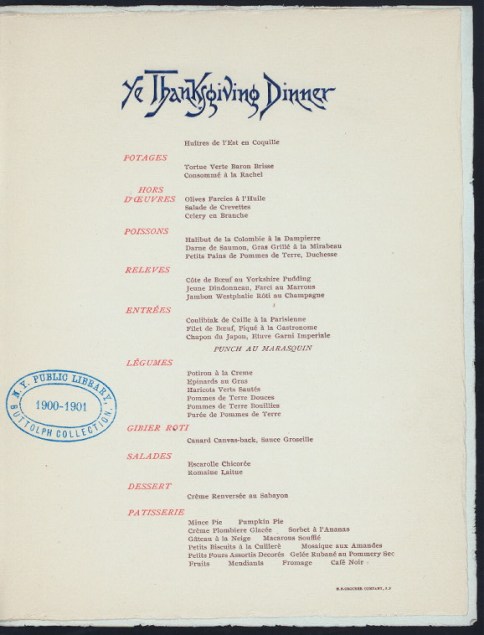
Photo Credit: “Thanksgiving dinner, Occidental Hotel, San Francisco, CA, 1891, scan by New York Public Library: Fee/Wikimedia Commons/PD scan (PD US expired)

But the aristocrats of the Gilded Age weren’t quite so committed to the idea of a family Thanksgiving. In fact, Gilded Age swells didn’t stay at home — they dined at the fanciest restaurants or hotel dining rooms. It was not unusual for Gilded Agers to feast on non-traditional Thanksgiving fair such as oysters, turtle soup, foie gras, prime rib, and Petit fours. The Thanksgiving menu at the Occidental Hotel in San Francisco (one of the swankiest of its day) hardly looks like the usual turkey with cranberry sauce, mashed potatoes, and pumpkin pie most Americans feast on nowadays.

We might be led to believe wealthy Gilded Agers weren’t as family-oriented as we are today, but as I pointed out in my blog post about the Gilded Age, people in this period in American history were obsessed with excess and an “over-the-top” feasting on life, especially those who could afford it. A family dinner at home simply didn’t fit in with their lifestyle. An extraordinary dinner at a fine hotel did, and many Gilded Agers used it as an excuse to show off their wealth and affluence with lavish clothes and jewelry. Many went to see and be seen.

If that sounds petty, keep in mind the concept of a family Thanksgiving was foreign to the Pilgrims as well. Pilgrims in the 17th century celebrated Thanksgiving with their neighbors and friends, often times without members of their families present, as many stayed behind in England or perished on the journey to America. Historians cite the 1920s Prohibition era and the Great Depression that follows as reasons why elaborate Thanksgiving festivities of the Gilded Age fell out of favor. That might be, but I’m guessing it had more to do with the post-World War II era when the family became more precious and important to Americans. This is why Rockwell’s illustration became so much a part of the American psyche and Thanksgiving associated with an intimate portrait of family.

Book 1 of the Waxwood Series, The Specter, gives the reader a taste of Thanksgiving in the 19th century. The holiday takes place in April, not November. In fact, until Franklin Roosevelt signed a proclamation making the third Thursday of November the official Thanksgiving holiday, you could find the day of thanksgiving during several different times of the year depending upon the state. If you’re curious, you can read more about that here

The Waxwood Series has just gotten a make-over! To find out more about the series, this page will give you all the details.

Is the life of a Gilded Age debutante all parties and flirtations? Read “The Rose Debutante” to find out! It’s FREE! Plus, you’ll get to know about life in the past and about the resilient women the history books forgot. And how about fun historical facts, great deals on historical fiction books, and a cool monthly freebie thrown in just because? Here’s where you can sign up.

instagram
Facebooktwitterredditpinterestmail

Gilded Age Technical Innovations: The Automobile

Facebooktwitterredditpinterestmail

Photo Credit: Henry Ford’s first car, a Quadricycle Runabout, 1896, Midcoast Studios, Henry Ford Museum: The Henry Ford/Flickr/CC BY NC ND 2.0

We might see the late 20th Century onward as the era of phenomenal technical innovation (think: personal computer, wifi, and the internet), but it was really the Gilded Age that started it. As I mentioned in this blog post, the Gilded Age (roughly the last quarter of the 19th century) moved us into the modern era where the 20th (and 21st) centuries took over. Everything was getting a make-over then, including fashion, business, and politics. Technology was no exception.

Although cars didn’t really become popular until they became affordable (when Henry Ford released the Model T in 1908), they’re still probably one of the most earth-shattering of all the technical inventions created in the Gilded Age. When exactly the first car was manufactured is a matter of dispute, though people generally cite Carl Benz (of Mercedes-Benz fame) as being the first to come out with a three-wheeled automobile that ran on gasoline. The contraption was pretty modest, looking almost like a three-wheel bicycle with a fancy leather seat. The car was created in 1879 but didn’t get its first run until 1886. 

The idea behind the early automobile can be found really in the word itself (which didn’t come about until 1897). The car was all about the ability to go where you wanted in a vehicle that ran on its own (as opposed to having an animal pull it). This is one reason why early automobiles were first referred to as “horseless carriages”. They were thought of as carriages just like any other (and many early 19th century ones looked more like carriages and wagons than the cars we know today) except they didn’t need a horse to pull them.

Interestingly, early automobiles didn’t necessarily run on gasoline. Many ran on steam power (using a smilier principle as the steam engine, another new technological innovation of the 19th century) and some even ran on electricity (hello, hybrid). In fact, early electric cars were often marketed to women (yes, women did drive cars in the early 20th century, including author Edith Wharton and society etiquette queen, Emily Post) because they were elegant and easy to operate. 

One of my favorite films is Orson Welles’ The Magnificent Ambersons (1942). The movie is based on a 1918 book (but takes place earlier) and documents the downfall of a wealthy Midwestern family. The shift from carriages to automobiles figures prominently in the story. Eugene Morgan, an old beau of Amberson matriarch Isabella, is a car manufacturer at a time when they were considered, in the words of Isabella’s son, a “useless nuisance”. In the film, there is a discussion of the automobile at the dinner table one night. The discussion brings out some of the fears people had about cars then, such as the value of exclusive neighborhood properties going down once cars allowed people to travel longer distances. Interestingly, the biggest “nuisance” we would consider with cars today (accidents) isn’t even mentioned, probably because the speed limit in the early 20th century was less than 20 miles an hour outside city limits. The philosophical speech Morgan delivers about the automobile is that, like it or not, no one could stop this technological innovation from replacing the horse and buggy and, of course, this prediction proved right. By the 1910s, cars outnumbered horse-drawn carriages in many cities across America.

Photo Credit: Baker Electric Coupe 1908, taken by Lars-Göran Lindgren: Lglswe/Wikimedia Commons/CC BY SA 3.0 

The Alderdices are, like the Ambersons, stuck in the past and are reluctant to embrace the new technologies that were already coming their way in the last decade of the 19th century. In Book 2, Jake and Vivian is introduced to a custom-made car belonging to Stevens called the Brata. The name is fictional but the car itself was inspired by a real electric car manufactured by the Baker Motor Vehicle Company in 1909. The car attracted me and fit Stevens’ character, like the kind of car he would really own, so I adopted it, although the series takes place some ten years earlier. Interestingly, Jay Leno, a classic car enthusiast, restored one of the Baker Electric 1909 automobiles and you can see him driving it here

Incidentally, cars also play a role in my upcoming historical cozy mystery series, The Paper Chase Mysteries. The protagonist and amateur sleuth, Adele Gossling, an up-and-coming New Woman, symbolically and literally invades the backward-thinking town of Arrojo in Book 1 when she shows up in a Beaton Roundabout (another fictional name for an automobile but inspired by the Stearns Steam Surrey, manufactured by the Stearns Steam Carriage Company in Syracuse, New York in 1902). If you’re curious, you can find a photo of the car here

The Waxwood Series is about to get a complete makeover! All four books will be getting new covers and new blurbs in November. You can find out more about the series here

Come join me for a peek into the corners of history! Curious about those nooks and crannies you can’t find in the history books? Are you more a people lover than a date or event lover when it comes to history? Then you’ll love the Resilient History Newsletter! Plus, when you sign up, you’ll get a prequel to my Waxwood Series for free! Here’s where you can sign up.

instagram
Facebooktwitterredditpinterestmail

The Second Wave Women’s Movement (1960s-1980s)

Facebooktwitterredditpinterestmail

This is the inaugural issue of Ms. Magazine from 1972. How many of those article headlines apply to us today in 2021?

Photo Credit: Preview issue of Ms. Magazine, Spring, 1972, Liberty Media for Women, LLC.: Missvain/Wikimedia Commons/CC BY SA 4.0

Women’s Equality Day is today and we want to celebrate!

It’s been a slow-going process for us to gain equality and even more slow-going to define for ourselves what that really means. The Merriam-Webster dictionary defines equality as “the state of being equal” (not very helpful, is it?) The word “equal” is defined as “of the same measure, quantity, amount, or number as another”. So equality is about sameness, right? It’s no wonder why many women (including one of my favorite musical artists, Kate Bush) mistake feminism for “wanting to be just like men”.

But from the beginning of its roots, the women’s movement was never about being “the same as men”. Suffragists wanted the vote (which they got in 1920) not because they wanted to think and act just like men, but because they wanted a say in public policies that affected them specifically, such as property laws, sanitary childbirth methods, and respect for their womanly virtues. 

But what’s more ironic is second-wave feminists defined equality as anything but sameness. The movement was, in fact, a highly personal one. It’s no wonder the feminist slogan became “the personal is political”. It grew out of mid-century women’s realization they were not living in a vacuum. Betty Friedan’s book The Feminine Mystique (which I talk more about here), was inspired by personal stories of the women she interviewed for women’s magazines in the 1950s, suburban housewives who had every material comfort but had lost their voices and their souls in the bargain. Again and again, Friedan heard tales of discontentment, anger, oppression, and guilt from these women which mirrored her own feelings. When the book was published, other women gathered in consciousness-raising groups and shared stories with one another. It was their desire to seek change for themselves and their sisters that sparked the movement.

In essence, the second-wave feminist movement begins where the suffragists left off. Suffragism (the right to vote) was what Victorian and Progressive Era women needed, a voice in the public sphere. Second-wave feminists of the 1960s took that voice to the next level. They identified issues affecting all women and lobbied for changes. For example, at the top of their agenda list was workplace discrimination. Issues such as affirmative action for women and abolishing segregated help wanted ads, which allowed employers to advertise jobs for women that they felt were suited to them based on gender, helped women get better jobs. This was a political stand, to be sure, but it was also a highly personal one that affected individual women’s lives.

Another issue of concern to women at this time was reproductive rights. The Pill was approved by the FDA in 1961, which was a major step forward for women. It gave many women the right to hold off having children until they (and not society) were ready for them. It also meant women who preferred to focus on a career and not have children could do so. They helped put the decision to “fulfill a woman’s role” (in conventional terms) in the hands of women and not men.

The second-wave women’s movement wasn’t all roses and chocolate, though. Within the movement, women didn’t always agree on what they should be fighting for. For example, Friedan became the first president of the National Organization for Women (NOW) in 1966 but stepped down four years later because she felt the increasing radical views coming from younger feminists didn’t gel with her own. NOW felt Friedan’s fight for working women wasn’t as high on the feminist agenda as she thought it should be.

In addition, women of color saw the movement dominated by middle-class white women and the issues most relevant to them neglected. They felt their experiences, especially with racism and classism, were overlooked and that separating discrimination by sex and by race was defeating the purpose of abolishing discrimination entirely. While there were many strong voices for women of color and their unique experiences (such as bell hooks and Angela Davis), they tended to be attached more to the civil rights movement than the feminist movement. Other women as well, such as working-class and LGBT women, pointed out the exclusion of issues more intimately related to them for those that affected their white, middle-class, educated sister more.

These omissions are, in fact, what the third-wave feminist movement (roughly, from the late 1980s to today) is about. That movement expands not only to all issues affecting all women personally but around the globe, which is why the movement has also been called “global feminism”.

How did the women who preceded the second-wave feminist movement feel in their lives? Read my book Lessons From My Mother’s Life to find out.  

Come join me for a peek into the corners of history! Curious about those nooks and crannies you can’t find in the history books? Are you more a people lover than a date or event lover when it comes to history? Then you’ll love the Resilient History Newsletter! Plus, when you sign up, you’ll get a prequel to my Waxwood Series for free! Here’s where you can sign up.

Do you think the “personal is political” approach still exists among the younger generation of women fighting for their rights in the 21st century? Let me know in the comments!

instagram
Facebooktwitterredditpinterestmail