Release Day Blitz for Adele Gossling Mysteries Box Set: Books 1-3!

Facebooktwitterredditpinterestmail

Title: Adele Gossling Mysteries Box Set 1: Books 1-3 (Adele Gossling Mysteries Box 

Series: Adele Gossling Mysteries

Author: Tam May

Genres: Historical Cozy Mystery

Release Date: November 25, 2023

Can a forward-thinking woman help the police solve crimes in a backward-thinking town?

“Great new series!”

Smart, inquisitive, and a firm believer in Progressive Era reforms, Adele Gossling seeks a new life after the devastating death of her father. She flees San Francisco for the town of Arrojo, planning a life of peace and small pleasures. But both elude her when she and her spiritual sidekick, Nin Branch, get involved in helping the local police solve the case of a dead debutante, a poisoned schoolteacher, and a family matriarch who may or may not have left a generous will.

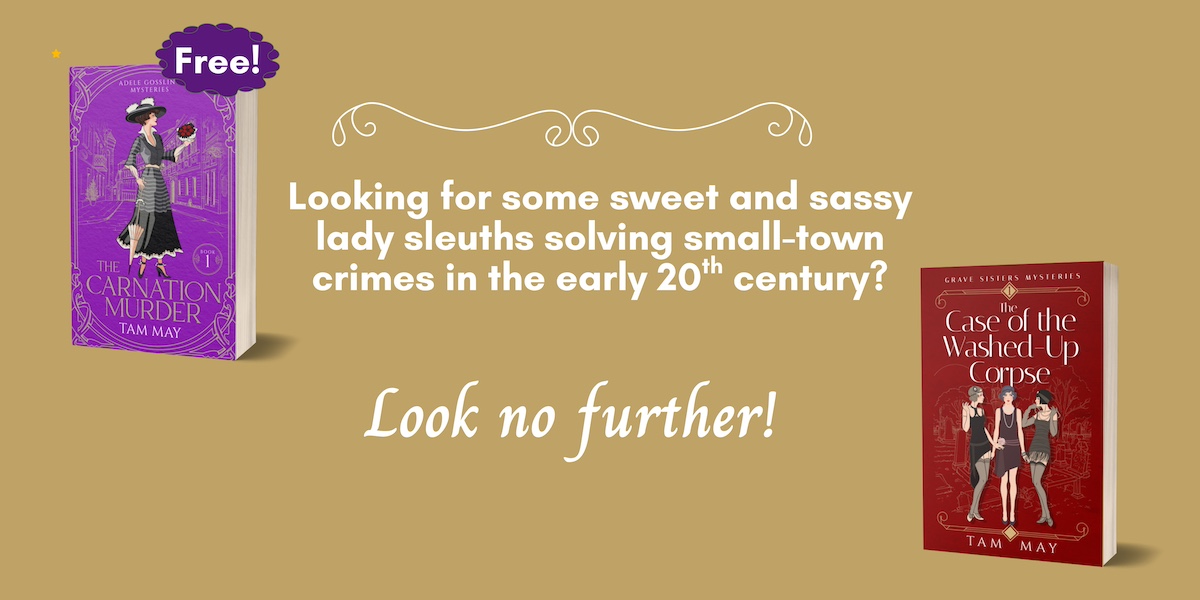
The Carnation Murder: Adele Gossling has barely been in Arrojo for a week when she discovers her neighbor’s dead body in her gazebo. Can Adele and Nin solve this puzzling case involving a striped carnation, a diamond ring, a note, a muddy pair of boots, and a broken promise?

A Wordless Death: Millie Gibb, the new teacher at the local girl’s school, is found dead and everybody in town assumes the homely, unmarried spinster committed suicide. Can Adele and her clairvoyant friend Nin prove Millie’s death was foul play based on a cigar stub, a letter fragment, and a cigarette lighter before the case is closed for good?

Death at Will: When the affluent Thea Marsh dies unexpectedly, the trail of suspects leads to Thea’s beloved and favored eldest son, Theo. Will Adele make a case against Theo’s guilt for the police out of a stained teacup, a fountain pen nib, ashes that should have been in the fireplace, and daisies that should have been fresh?

Pick up this box set of the first three Adele Gossling Mysteries and immerse yourself in turn-of-the-century Northern California in all its dynamic and chaotic glory for a fun and cozy read!

You can get your copy of this box set at a special price at the following online retailers.


About the Author

Writing has been Tam May’s voice since the age of fourteen. She writes stories set in the past that feature sassy and sensitive women characters. Tam is the author of the Adele Gossling Mysteries which take place in the early 20th century and features suffragist and epistolary expert Adele Gossling whose talent for solving crimes doesn’t sit well with the town’s more conventional ideas about women’s place. She has also written historical fiction about women breaking loose from the social and psychological expectations of their era. Although Tam left her heart in San Francisco, she lives in the Midwest because it’s cheaper. When she’s not writing, she’s devouring everything classic (books, films, art, music) and concocting yummy plant-based dishes.


Social Media Links

Facebook: https://www.facebook.com/tammayauthor/

Instragram: https://www.instagram.com/tammayauthor/

Pinterest: https://www.pinterest.com/tammayauthor/ 

Amazon Author Page: https://www.amazon.com/Tam-May/e/B01N7BQZ9Y/ 

BookBub Author Page: https://www.bookbub.com/authors/tam-may

Goodreads Author Page: https://www.goodreads.com/author/show/16111197.Tam_May

instagram
Facebooktwitterredditpinterestmail

The War That Didn’t End All Wars: World War I

Facebooktwitterredditpinterestmail

Today is Veteran’s Day, and we want to honor all people who fight for our country. I want to look at a war that is sometimes forgotten, or, rather usurped by its older brother later in the 20th century: World War I.

There’s no doubt World War II has gained in popularity in the last several years. There was a time when you looked on the Amazon bestseller list for Historical Fiction and saw only (or mostly) books set during the Second World War. But World War I has always been more fascinating to me. I got interested in this war after binge reading Dorothy L. Sayers’ classic series featuring Lord Peter Wimsey. Though the series is set in the 1920s, Wimsey is a World War I vet and there are references to his experiences during the war and even a mystery with the foundations set during the war in the book The Nine Tailors

When we look at the history of World War I, we find people had very high hopes for it. It was, and still is, referred to as “The Great War” (even though few would deny World War II was greater) and “the war to end all wars” (which, sadly, it did not). This war was a modern war and a coming-of-age for warfare.

Photo Credit: American Soldiers on the battlefield in France during WWI, date unknown, U.S. National Archive: Picryl/Public Domain

World War I was the first war fought on a grand scale, involving 30 nations (including the United States). Wars up until that time tended to be confined to certain geographical areas so this war was the first real global war. 

It was also the first to use modern technologies such as tanks, machine guns (the infamous “Tommy gun” was originally designed to be used during the war), automobiles, and airplanes. That made mass destruction easier (sad to say) and so the toll it took physically on those fighting, including the dead and wounded was massive. The total casualties are estimated to be around forty million! While WWII  had about twice the casualties, for the early 20th century, this was phenomenal.

But what made World War I stand out above other wars before it was the psychological toll it took on those fighting and on their loved ones. Since such death and warfare hadn’t been seen on a massive scale before, the devastation it brought was huge. Post-World War I was the first time people began to recognize war could cause heavy psychological damage. A new term came into being after the war: shell shock (which we know today as PTSD). One of the things that fascinated me about Sayers’ series is how she shows the effects of shell shock on her protagonist Lord Peter Wimsey even a decade later, including nightmares, migraines, and nervous breakdowns. 

So let me call out to honor those who fought and died in World War I. Sadly, none survive today, as the last died in 2011. But we can still appreciate their bravery and the way they showed us the effects of global war.

If you love fun, engaging mysteries set in the past, you’ll enjoy my novella The Missing Ruby Necklace! It’s available exclusively to my newsletter subscribers and you can get it here. By signing up, you’ll also get news about upcoming releases, fun facts about women’s history, classic true-crime tidbits, and more!

instagram
Facebooktwitterredditpinterestmail

Death Outside the Battlefield: Lida Beecher

Facebooktwitterredditpinterestmail

Last month, I posted a tribute to World War I veterans. The war made people realize death can come too easily in the 20th century. However, not all deaths in 1914 took place on the battlefield. Some, in fact, happened in the backwoods of America and were just as shocking as those happening in Europe. 

Book 2 of the Adele Gossling Mysteries is about the death of a schoolteacher. During my research, I stumbled upon the case of Lida Beecher which both horrified and intrigued me. I wasn’t the only one. Residents of Herkimer County, New York where the murder took place were so devastated by the crime that a history of the area written in the 1970s completely excludes any mention of it. 

The story involves many complex players. To begin, the victim is Lida Beecher, a young and lovely schoolteacher whose eagerness to help her students usurped her experience in dealing with the troubled ones. Then there is the perpetrator: Jean Gianini, a sixteen-year-old from a very unstable family environment that included alcoholism, mental disabilities, and physical abuse. Gianini lured Beecher into the woods, hit her with a monkey wrench, and then stabbed her to death, hiding her body in the brush. 

The case exemplifies the limitations of education and medicine in the early 20th century. Schools at this time, especially in rural towns, were a one-room affair (think: Little House on the Prairie). Students of all ages attended and the teacher had to accommodate different learning levels, from the six-year-olds to the fifteen and sixteen-year-olds. Teachers were then, as they are now, grossly underpaid and they were also undertrained, especially in dealing with special needs children or children with disabilities. 

Photo Credit: Herkimer County Courthouse where the trail of Lida Beecher’s murder took place, Herkimer, NY, 19 September 2009, taken by Doug Kerr: Pubdog/Wikimedia Commons/ CC BY SA 2.0

All the sources on the case agree Gianini was both intellectually and mentally below average. During the trial, he went through several intelligence tests, including the Binet Test, which was used at the time to assess the mental age of children, and he was found to have the intellectual capacity of a ten-year-old even though he was sixteen. He also showed signs of mental disabilities. Some have said if Gianini were examined today, he would probably be diagnosed on the autism spectrum. Accounts of his time at school clearly showed neither his teachers nor the principal were equipped to understand or help him. Beecher tried but when he misbehaved, she called in the principal, who resorted to the same kind of humiliation and violence Gianini experienced at home. This set off feelings of resentment in Gianini and vows of revenge and, indeed, he gave his reason for killing Beecher as vengeance. 

The case set the precedence for the insanity plea, which became almost overused in the early 20th century. The defense was able to convince a jury that Gianini didn’t know what he was doing and get him committed to an institution rather than suffer the death penalty.

Teachers don’t fare well in Book 2 of my Adele Gossling Mysteries, A Wordless Death, either. The book is part of my 3-book box set, which includes Book 1 (The Carnation Murder) and Book 3 (Death at Will) is on preorder right now. So to get 3 books at a great price, check out this link

instagram
Facebooktwitterredditpinterestmail

Resort Life in the 19th Century

Facebooktwitterredditpinterestmail

When doing some research recently, I discovered that today is the day summer officially ends and fall begins.

This summer hasn’t been easy for many of us. I recently moved from Texas to Ohio and it looks like I might have chosen a good time to leave, as many of my Texas friends experienced higher-than-usual temperatures this summer (I’m taking 105 and 106-degree type weather). Even in the Midwest, people told me it was an unusually hot and humid summer for our town. One of my neighbors posted the following sign on her lawn, maybe in an effort to encourage the colder weather to come:

A few weeks later she took it down. I guess she got discouraged by the continuing high temperatures!

In the 19th and early 20th centuries, when there were no A/C units, no cooling systems, and fans that were inadequate, summer was the time for people to get away. Remember my blog post about Grace Brown and Chester Gillette (which you can find here)? Gillette lured his victim to the Adirondacks with the promise of a honeymoon vacation. The Adirondacks was a popular resort town in the East in the early 20th century.

Both Brown and Gilette were working-class people, and at the turn of the century, resorts such as the Adirondacks were just becoming accessible to them. But for the very wealthy, such resorts had been at their disposal since the 19th century. There were even those who made hopping from resort to resort a way of life.

Photo Credit: The Beach and The Sea, Blankenberghe, Belgium, from “Views of Architecture and Other Sites in Belgium” catalog, 1905, Detroit Publishing Company: Fae/Wikimedia Commons/PD Art (PD old 100)    

Resort life for the wealthy, as Charles Dudley Warner depicts in his book Their Pilgrimage (1884), was relaxing, exciting, and, oftentimes, boring. Some traveled for their health to places such as Palm Springs in California. Others traveled in the winter to get away from the harsh weather in their hometown. And many did it because it was “the thing to do” among the wealthy. 

The idea of seeing and being seen was prevalent throughout the late 19th and early 20th centuries, and resort life offered just the place for this. What people did or what they saw in terms of the local attractions was less important than who they met and mingled with. At the same time, the anonymity of resort life gave the tightly-laced blue bloods of this time freedom to be themselves, a luxury they couldn’t afford at home. Away from the resorts, the wealthy had to watch what they said and did so as not to be shunned by their neighbors or get their names in the papers. But at a hotel, no one knew them, and they could loosen their grip a little bit.

Resort life was predominantly for women, though there were men and children as well. The hard-working, aggressively competitive Gilded Age and Progressive Era man couldn’t take time off for vacations. Ironically, women found a level of release and independence in the resort hotels that they couldn’t have at home, with the rigid boundaries of the separate spheres

Those who have read my Waxwood Series know the way of life of resort towns well. The Alderdice family aren’t exactly the kind of Gilded Age travelers that Warner’s novel depicts, as their lives are firmly rooted in San Francisco society. But, like their blue blood companions, they take full advantage of the extravagances offered once they do arrive and, in more ways than one, they become different people immersed in resort life for even just that short a time.

You can read about the Alderdices’ experience of resort life in Book 2 of my series, False Fathers. Book 3, Pathfinding Women, coming out this summer, also gives you a sense of resort life in the last year of the 19th century. If you want to find out more about the Waxwood Series, you can check out this page.               

The Adele Gossling Mysteries is grounded more in the grim realities of murder and crime, but I’m not quite done with resort life yet in my books. I already have on my agenda to write a book for this series set in a resort town which will include all of its fascinating psychological aspects amid a backdrop of crime and mayhem.

In the meantime, you can pick up The Carnation Murder, the first book of the series, for free from all book vendors. All the information and links are here. And if you’re interested in a more dramatic look at resort life, you’ll find my Waxwood Series right up your alley. You can start with Book 1, The Specter, which is free on all vendors, here

If you love fun, engaging mysteries set in the past, you’ll enjoy The Missing Ruby Necklace! It’s available exclusively to newsletter subscribers here. By signing up, you’ll also get news about upcoming releases, fun facts about women’s history, classic true-crime tidbits, and more!

instagram
Facebooktwitterredditpinterestmail

The Wage Gap: Is This Still a Thing?

Facebooktwitterredditpinterestmail

Today is Labor Day in America, which means we’re celebrating the working woman and man. Women indeed have a lot to celebrate on this day. Working conditions for women have improved dramatically since the early 20th century, and job opportunities for women have expanded considerably. Many workplaces recognize situations related to women that made it difficult for them to work in the past and accommodate these (such as maternity leave and daycare). And sexual harassment in the workplace has largely been addressed.

But one thing we can’t celebrate is the wage gap. That is, women are still not being paid equally to men on average for the same or similar jobs. 

Photo Credit: Dolly Parton, Lily Tomlin, and Jane Fonda, Washington D.C. Kennedy Center, taken 21 August 2019: Edithian/Wikimedia Commons/CC BY SA 2.0

One of my favorite scenes in the classic comedy 9 to 5 is the closing (spoiler alert if you haven’t seen the film). As the three office workers (Jane Fonda, Lily Tomlin, and Dolly Parton) are going around with the head of the company, showing him all the positive changes they’ve made (like flex time and in-house daycare), the head tells their boss (Dabney Coleman) that the one change he doesn’t approve of is paying women in the company the same as the men. As the credits close and the women are toasting their success, they recognize the wage gap is still an issue. I love this scene because even though by 1980, the second-wave women’s movement had lost a lot of its earlier steam, partly because many women believed they had won the fight, it’s a reminder that the fight was (and is – see this blog post) on.

The wage gap has existed for centuries. In the Victorian era, when fewer women were in the workforce and few had careers, women were often paid half or less what men were paid. The reasons for this were, according to employers, practical. According to the separate spheres, men were the bread winners and expected to support their families so they needed more money (a point Coleman makes to Tomlin in 9 to 5 when he tries to justify his reasons for giving a promotion she’s been wanting to a less capable male colleague). Women were at that time not expected to work for long, since their true calling (per the separate spheres) was marriage and motherhood. Employers didn’t want to pay full wages to workers whom they viewed as temporary (even if they weren’t). In addition, women’s work was undervalued because they were seen as “the weaker sex”. The jobs they performed were limited to what employers thought they could do for the most part (read: boring, repetitive tasks, such as in the factories) and therefore, valued less than men’s.

There was one period in American history where women earned more or less the same as men: World War I. During the First World War, when men were scarce and workers were needed for the war effort, government officials agreed to pay women the same as men to entice them into the offices and factories, and many non-government employers followed suit. Sadly, this didn’t stick, not even during World War II when employers again needed women workers (women got paid about forty percent of what men earned during the Second World War).

Just like the ladies of 9 to 5, we’re still fighting the wage gap in the 21st century. Mid-20th century women were receiving a little more than half the wages of men on average, and that number remained pretty steady after the war. It’s only increased to about eight-three percent, according to a study done in 2020. So we’re getting closer but we’re not there yet.

I believe in the working woman, which is why there are a lot of them in my Adele Gossling Mysteries. There are a number of women entrepreneurs (including Adele herself), but there are also women working for employers (such as the young ladies rooming at Mrs. Taylor’s boarding house, whom readers meet in Book 2). The victim in my new release, The Case of the Dead Domestic is, as the title implies, a maid working for a wealthy family when she gets killed. You can check out this sixth book of the series here

As for the practices of Labor Day in the early 20th century, you can experience what that was like in Book 4 of the series, which takes place on the holiday in 1904!

If you love fun, engaging mysteries set in the past, sign up for my newsletter to receive a free book, plus news about upcoming releases, fun facts about women’s history and mystery, and more freebies! You can sign up here

instagram
Facebooktwitterredditpinterestmail