Chaos and Commerce: The Gilded Age

Facebooktwitterredditpinterestmail

Big businesses controlled the government in the Gilded Age. In this cartoon, big business is represented by “the robber barons,” the name given to railroad tycoons (and the businesses that made them possible, such as steel), pictured as bloated bags of money, lording over the tiny mice of the senate. 

Photo Credit: The Bosses of the Senate cartoon, Joseph Ferdinand Keppler. First published in Puck, 23 January 1889, lithograph, colored: P. S. Burton/Wikimedia Commons/PD Art (PD Old 100 1923)

I’ve been fascinated by the Gilded Age since 2009 when I went back to school for a short time, intending to get a Master’s degree in history, and took a course on the Gilded Age. For some reason, the Gilded Age got buried in the annals of American history in favor of other eras. Most notable were the 1920s, which made a comeback ten years or so ago when the film The Great Gatsby was released, and World War II, which still dominates the bestseller lists in the historical fiction genre.

There is some dispute as to the time frame we know of as the Gilded Age. Most historians and scholars don’t dispute it began in the 1870s. But some consider the mid-1890’s the end of the era while others push the end to 1900. For my purposes, because the new century brought about the Progressive Era, I consider 1900 as the stopping point.

The publication of Mark Twain and Charles Dudley Warner’s The Gilded Age: A Tale of Today in 1873 coined the term. Ironically, the title wasn’t meant as a label for the era but as a tongue-in-cheek dig against it that turned out to be wildly accurate. When we think of the word “gilded” we think of something that is bright and shining but also fake and misleading. With a sharp eye and sardonic humor, Twain and Warner observed what was going on around them and used it as fodder for their fiction. The book, which is actually my favorite of all Twain’s work, depicts various scoundrels, fools, and charlatans who seek success and prosperity by taking advantage of the era’s propensity for “wheeling and dealing” — and getting away with it because the American public was too naive or ignorant or both to see through them (this would be rectified in the Progressive Era). 

What was happening in America was, in the context of the time, understandable. When Twain and Dudley Warner published their book in 1873, America was going through a recession that ended with the Panic of 1873. People were determined to bounce back financially and politically to show the world the United States was anything but finished. Since finance and politics are, let’s face it, inherently dirty, many used dirty methods to do it. Stories of graft, greed, and corruption permeated every corner of American life. Money and commercial interests ruled. In an effort to encourage the kind of economic growth that could rival European markets, America became, as the saying goes, too big for its britches.

This painting represents the kind of gaudy extravagance common with the very rich during the Gilded Age, especially when they entertained.

Photo Credit: Photo Credit: Hofball in Wien. Aquarell, Wilhelm Gause, 1900, Historisches Museum de Stadt Wien: Andrew0921/Wikimedia Commons/PD Art (PD Old)

As many of us know, when Americans have money, they aren’t shy about spending it. All this wheeling and dealing created a new class of aristocrats. Novelists such as Edith Wharton and Henry James wrote about the nouveau riche (people who had recently become wealthy through business rather than inheritance) infiltrating the established societies of big cities like New York and San Francisco where “old money” families dictated what was and wasn’t socially acceptable. The recently launched series The Gilded Age is all about a young woman trying to break into the heavily guarded New York upper class.

The Gilded Age became notorious for the gaudy displays of the socially privileged. The very rich became very extravagant, sometimes ridiculously so, displaying their money and social power even in the face of the growing poverty and working-class resentments that would explode into the unions and reforms of The Progressive Era.

Perhaps it’s not surprising that Twain and Warner’s book did not do well when it was published. An important critic of the day, author William Dean Howells, thought it degenerative and disgusting. In the 21st century, the book gives us a new way of looking at social, economic, and political life with an eye toward not repeating the same mistakes (we hope!).

If you’re interested in the Gilded Age, you’ll want to check out my Waxwood Series, a family saga set in the last decade of the 19th century. It’s a great time to do that because I’ve just updated and revised Book 1, The Specter, to make it even better! And you can get it for FREE on all book vendors. For more details, go here.

If you love fun, engaging mysteries set in the past, you’ll enjoy my novella The Missing Ruby Necklace! It’s available exclusively to my newsletter subscribers and you can get it here. By signing up, you’ll also get news about upcoming releases, fun facts about women’s history, classic true-crime tidbits, and more!

instagram
Facebooktwitterredditpinterestmail

Where All The Cool Crime Writers Go: The Detection Club

Facebooktwitterredditpinterestmail

How would you like to be a member of a secret club that once included Agatha Christie, Dorothy L. Sayers, C.S. Lewis, and J. R. R. Tolkien? I don’t know about you, but as a mystery fiction writer, my answer would be “Sign me up!”

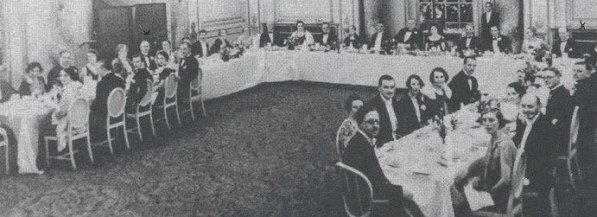
Did such a club really exist? It did indeed. It was called The Detection Club and it begin in 1930 at the height of the Golden Age of Crime Fiction. Some of its founding members were those mentioned above. These British mystery writers wanted to form a community of like-minded authors working in the genre of crime fiction (the majority of them writing traditional “whodunits”). They realized the benefits of having their own version of a Facebook group in the days when there was no Facebook and even no internet. 

Photo Credit: Meeting of The Detection Club when GK Chesterton was its president, 1930s, unknown author: Peter Philim/Wikimedia Commons/PD UK 

Although the club had some confidential rituals (it was a secret club, after all), there were some that are known to us which, on the face of it, sound corny at best, ridiculous at worst. For example, the initiation ceremony required new members to place their hand on a skull and take the following oath while the president of the club stood over them dressed in a red cloak and carrying a torch:

“Do you promise that your detectives shall well and truly detect the crimes presented to them using those wits which it may please you to bestow upon them and not placing reliance on nor making use of Divine Revelation, Feminine Intuition, Mumbo Jumbo, Jiggery-Pokery, Coincidence, or Act of God?”

Sounds pretty silly, right? But the club’s initiation oath shows its members took crime fiction very seriously. In fact, their approach to the genre was based on rules set by Ronald Knox, one of its members. Knox created the “Knox Commandments” which, among other things, set ground rules for writing mystery stories that would ensure authors played fair with readers. Some of these rules included avoiding cliches such as too many secret rooms, supernatural forces interfering with the amateur detective’s efforts to solve the crime, and coincidences popping up out of nowhere at just the right moment. You can read the Knox Commandments here (but be warned some rules might not gel with our more enlightened 21st-century ideas).

The Detection Club wasn’t just about poking fun at mystery tropes and cliches (the skull and red cloak). They were a serious group dedicated to educating their members and improving the standards of mystery fiction. Crime fiction in the mid-20th century was too often given the status of pulp fiction, and they wanted to prove mysteries were just as good as any other genre. To this end, members were able to attend lectures by crime and forensic experts and social gatherings where they could mingle and get insights on improving their craft from other members. 

My first exposure to The Detection Club was a while back when this link showed up in my inbox. I was intrigued that, first of all, so many of my absolute favorite classic mystery writers not only knew one another but were members of the same club. I was also fascinated by the club’s integrity and commitment to “fair play” and its determination to see that its members followed those rules.

Does the club still exist today? You bet it does! It still caters to the genre’s elite and boasts PD James, Colin Dexter, and Ruth Rendell on its member list. I’m not sure the ritual of the skull and cloak is still in use, but the club is all about maintaining the integrity of mystery fiction and creating a social circle where mystery writers can improve their craft. 

Want to read mystery fiction that avoids divine revelation, mumbo-jumbo, and jiggery-pokery (but maybe not the feminine intuition, at least, not entirely)? Take a look at the Adele Gossling Mysteries! The first book will be out on April 30, but you can preorder it at a special price here. 

If you love fun, engaging mysteries set in the past, sign up for my newsletter to receive a free book, plus news about upcoming releases, fun facts about women’s history and mystery, and more freebies! You can sign up here. 

Works Cited:

The Detection Club oath: https://elegsabiff.com/2013/04/20/a-z-challenge-rules-of-the-detection-club-circa-1929/ 

instagram
Facebooktwitterredditpinterestmail

Who was Miss Marple REALLY?

Facebooktwitterredditpinterestmail

We hear a lot about famous male sleuths like Sherlock Holmes, Charlie Chan, Father Brown, and, of course, Agatha Christie’s Hercule Poirot. They’ve become so famous that after Christie wrote the last Poirot book in 1975, The New York Times published Poirot’s obituary (if you don’t believe me, check this out). 

But until recently, we haven’t heard much about famous female sleuths. That’s because, before Maisie Dodd and Jessica Fletcher, there just weren’t that many around. If called upon to name a famous amateur female sleuth, most people would probably think of Agatha Christie’s Jane Marple.

Marple often gets forgotten in the Christie canon because Poirot was more famous. Given a few quirks, he fits the stereotype of the famous detective while Miss Marple sort of slips through the cracks. Marple is anything but typical of what we might think of as an amateur detective — elderly (Christie’s books hint she’s in her seventies), hedgy, and mild-mannered, with a tendency to ramble on about the little world of her hometown, St. Mary Mead. 

In one of his books on writing, crime author Lawrence Block confessed he likes Marple much more than Christie’s other famous detective, claiming she is more interesting and complex than Poirot. 

I’m a huge fan of the Poirot series, largely after binge-watching the hit British series Poirot (side note: If you’re a fan of Christie and have never seen this series, I highly encourage you to get hold of it. David Suchet nails the Poirot character in looks and mannerisms and really makes the character come alive). I’ve read a few of the Marple books and, to be honest, Miss Marple didn’t impress me. Her wishy-washiness and tangents about St. Mary Mead just got on my nerves. Nevertheless, I could see what Block was talking about. Underneath the grandmotherly countenance and knitting needles lurks a very shrewd and observant mind. 

Photo Credit: Margaret Rutherford as Jane Marple, Murder at the Gallop, 1963, taken 2 October 2006 by Mr. AEL: Mr. AEL/Flickr/CC BY NC ND 2.0

Actually, Marple wasn’t the first woman sleuth of advanced years. In fact, Christie took her inspiration for Marple from another not-so-young character who helped the police solve crimes. She was Anna Katharine Green’s Amelia Butterworth. Green was an American crime writer who wrote some years before the Golden Age of Crime Fiction. Green wrote three novels featuring Butterworth, with the first published in 1897. Butterworth is a Gilded Age creation, as, in spite of her age, she has the independent spirit and a gutsiness that would characterize the much younger generation of New Woman emerging at that time.

Interestingly, many film and TV versions of Miss Marple have tried to bring a little life into her beyond Christie’s rather limited vision of the elderly woman sleuth. Probably the most well-known of these was British actress Margaret Rutherford’s Marple. Although Rutherford’s Marple was always with her knitting needles, she looked more likely to poke somebody’s eyes out than make a sweater with them. Rutherford gives Marple the feminist “oomph” she needs, reminiscent of the earlier Butterworth. Although there were only four films made in the Marple series in the 1960s (and one of them was actually based on a Poirot book), they established the image of the lady sleuth we most often think of today — shrewd, tough, and taking no BS from anybody. 

How about some more women sleuths with “oomph”? Check out my new Adele Gossling Mysteries, launching on April 30. The first three books are up for preorder and the first is only 99¢. You can find out more here. 

If you love fun, engaging mysteries set in the past, sign up for my newsletter to receive a free book, plus news about upcoming releases, fun facts about women’s history and mystery, and more freebies! You can sign up here. 

instagram
Facebooktwitterredditpinterestmail

Why I Love (And Write) Women’s Fiction

Facebooktwitterredditpinterestmail

***This blog post was written in honor of Women’s Fiction Day, designated as June 8 by the Women’s Fiction Writers Association.***

If you would ask me what is the genre of the Waxwood Series, I would unhesitatingly say “women’s fiction”. This is in spite of the fact that False Fathers, Book 2 of the series, is actually about a young man’s coming-of-age. The series itself focuses on the journey of one young woman to emotional and intellectual maturity in the last decade of the 19th century. Women’s fiction is always about journeys and all of my fiction, regardless of genre, even my upcoming historical cozy mystery series, the Paper Chase Mysteries, is about women’s journeys.

But is women’s fiction only about the gender of the author?

Different authors define women’s fiction (whether they write it or not) differently. My definition of women’s fiction is fiction where a woman goes through some kind of emotional and psychological journey and transformation, usually the main character or one of the main characters. That transformation doesn’t necessarily have to be a positive one, but one in which she learns something about herself and the world around her. And the book doesn’t have to be written by a woman either. I consider books like Leo Tolstoy’s Anna Karenina and Gustave Flaubert’s Madame Bovary women’s fiction, because the woman protagonist of each book goes through her own journey and transformation (however tragic), and we learn something about human nature and women’s lives in the nineteenth century. 

This last element is really why I love reading women’s fiction. The genre not just about women written for women and only relevant to women. It’s relevant to all our lives, male or female, or however you identify your gender. They also teach us about how women behave and are treated, and this reflects on the way human nature works in our patriarchal society, then and now. I make no secret of the fact that I don’t read many contemporary books but a few months ago, I picked up a book firmly placed in the contemporary women’s fiction category by K. L. Montgomery titled Fat Girl. Montgomery is a body-positive advocate and her protagonist is a plus-size woman whose trials and tribulations with romance, divorce, and raising a teenage boy speaks to our time with the struggles of single parents and body shaming in our weight-conscious society.

In the Waxwood Series, Vivian’s transformation continues throughout the Waxwood Series and will be completed in Book 4. Her revelations about family, women and social expectations will hopefully speak not only of the paradoxes of the Gilded Age but also our time.

In honor of Women’s Fiction Day, I’m giving away an ebook copy of The Specter! To enter the giveaway, please comment on this blog post and tell me why you love women’s fiction (historical or otherwise). The giveaway will end on Sunday, June 13.

instagram
Facebooktwitterredditpinterestmail

Social History: Putting the Human Element Back into History

Facebooktwitterredditpinterestmail

Photo Credit: Dudley Street, Seven Dials, 1872, Wellcome Images, Wellcome Trust, UK: Fae/Wikimedia Commons/CC BY 4.0

I’m starting out this year as a revisionist (in a sense). I’m revising my perspective on my writing and my passion for history by examining what really makes them tick. For those who have been following my blog for a while, you know I’ve had several transformations in the past years. I started out in 2017 as a contemporary literary fiction writer believing in psychological reality in fiction, something I am still fascinated by and still incorporate in much of my fiction. Then I discovered a way to transform my passion for history, especially women’s history, into stories about resilient women and the nooks and crannies of history that don’t always come up in historical fiction. 

Last year, I completed the Waxwood Series, my Gilded Age family saga set among San Francisco’s elite. I discovered that my real passion for history lies more in its social and psychological aspects rather than its politics and events. Those terms can sound a little vague and academic, so this month, I’ll be talking about what social history is and what it means in my fiction.

Let’s begin with a simple definition: Social history is history with the human element thrown in. Not that political or economic history isn’t about humans, as all history inevitably is. But you’re more likely to read a book about or set in the Civil War, say, where the people or characters are players in the big event. Social history looks at the people who participated in history, how they were affected by it, and how they influenced it. In my Civil War example, a novel might be about African American soldiers (actual or fictional) and their daily struggles not only with the war itself but with the racism surrounding them on the battlefield, forsaking a more blow-by-blow account of the events of the war. Social history gives us a window into the way people lived and breathed in their time and, sometimes, the values and beliefs they held that we want to acquire or release in the 21st century.

Social history is actually an academic field of study that emerged in the turbulence of the 1960s and 1970s. This isn’t much of a surprise, since much of the social awareness that emerged during these times required knowledge of the past. For example, the Civil Rights movement was built on the oppression and heinous crimes of slavery and on racism not only of the present but of the past. Similarly, the second-wave feminist movement, as I discuss here, took the issues the 19th-century suffragists were fighting for to the next level.

When I say I focus more on social history than on political and economic history, I mean that how my characters live and relate to their environment matters to me. The more academic perspective of social history often looks at the bigger picture, like the movements, systems, and structures of history. These are important, but I also find the way people related to these social structures and lived within them (or rebelled against them) is part of what makes history so fascinating and relevant to us today. 

Vivian Alderdice, the main character of the Waxwood Series, is a great example. Like many 19th century women, she is locked in social systems and structures with very rigid definitions of what women should and shouldn’t do. She’s a member of the Nob Hill elite, adhering to the social norms of the aristocratic class (which is especially true in Book 3 of the series, Pathfinding Women). Later, she moves into suffragism and progressivism, but, just as she had to revise her position in her Nob Hill world, she also has to examine her values and beliefs against those of her new world (which you can read about in the last book of the series, Dandelions). 

In my upcoming historical mystery series, The Paper Chase Mysteries, social history plays a huge role. The series begins in the first years of the 20th century when many people were still reluctant to leave behind Victorian values for the complexity and fears of the modern. Like Vivian, the series main character is a social reformer, and when she moves from San Francisco to the small, dusty town of Arrojo, her forward-thinking ideas aren’t always embraced, appreciated, or understood. 

You can find out more about that series here. The first two books of the Waxwood Series, which were re-edited and refreshed in 2020, are here and here. 

Want to explore the nooks and crannies of history that aren’t in the history books? Like social and psychological history and not just historical events? Want in on exclusive sneak peeks, giveaways, and surveys? Then sign up for my newsletter! You’ll get a free short story when you do.

instagram
Facebooktwitterredditpinterestmail