Dangerous Lengths: A 19th Century Review of Henry James’ The Bostonians

Facebooktwitterredditpinterestmail

June kicks off LGBTQ+ Pride Month. The LGBT community has made great strides in the 20th and 21st centuries and faced so many battles to have the LGBT identity recognized and respected. I remember as a teenager watching MTV Europe in 1984 and seeing the powerful music video depicting the stark reality of being gay in the 1980s in Bronski Beat’s “Smalltown Boy”. Thankfully, the gay community has come a long way in these last 40 years.

LGBT identities existed in the 19th century, though, of course, they were much more covert. I mentioned in my blog post about Boston Marriages and the New Woman, “marriages” between women who chose to remain independent and live with other women in a shared household, whether this included intimate relationships or not. One such relationship was depicted in Henry James’ 1886 novel, The Bostonians. The novel was made into a film in 1984 and does not shy away from the lesbian subcontext, and won several awards and nominations, especially for Vanessa Redgrave, who plays Olive in the film.

Photo Credit: photo of Henry James, before 1904, H. Walter Barnett, The English illustrated magazine: JB Hoang Tam/Wikimedia Commons/PD Old 70 Expired

However, when James’ novel came out, it did not receive a warm reception. Its contemporary themes of the New Woman in the Gilded Age and her fight for women’s suffrage were on the minds of many people, and James’ novel gets right into the thick of it. The novel depicts the lives of three characters: Olive, an upper-middle class Bostonian suffragist whose shyness keeps her from being a spokeswoman for the movement; Verina, a young and vibrant spiritualist of a lower class whom Olives gets involved in the movement; and Basil, Olive’s cousin, a conservative Southerner who develops a romantic interest in Verina and becomes hell-bent on “saving” her. The novel is a triangle love story of sorts, but in the shadow of the fight for women’s rights at that time.

One contemporary review from The Atlantic in 1886 is interesting in how it shows the attitude of many people toward the suffragist movement and Boston Marriages. The reviewer, Horace Elisha Scudder (a Victorian name if I ever saw one!) isn’t exactly kind toward James or his characters. He seems to take the biggest issue with Olive, describing her in very “masculine” (for the time, based on the separate spheres) terms. He sees her as arrogant and aggressive in the way that would have been expected and welcomed of the Gilded Age man. Verina is equally stereotyped as the “feminine” in their Boston Marriage, a young, twittery sort of person whose spiritualism Scudder considers to be on par with the fake mesmerizers of the time.

Scudder isn’t shy about depicting his disdain for the relationship between Olive and Verina, which makes up the main storyline. He never uses the word “lesbian,” but his description of their romantic partnership shows he was well aware of what was going on between them, and he doesn’t approve. He uses words like “vulgar” and “repellent” to describe their relationship. He also expresses his distaste for the way that Olive, who offers Verina shelter in her house to develop her skills as a suffragist spokeswoman, is part of the “dangerous lengths” she will go to for the sake of the movement. In his eyes, their relationship can’t be “natural” or “reasonable”. 

What is telling is that Scudder is interpreting the plot of the novel as a love triangle, the fight between Olive and Basil for Verina’s heart. However, he fails to see the real intent of James’ novel. It was not so much the battle of the sexes with Verina as the prize, but the experience of love in Olive’s lonely and isolated life, which leads her to at last come forward as a spokeswoman for the suffragist movement. It’s no surprise that a critic with his eye on the separate spheres would fail to see the relationship between Olive and Verina as helping to bring out Olive’s identity. 

instagram
Facebooktwitterredditpinterestmail

America’s Mini War: The Spanish-American War of 1898

Facebooktwitterredditpinterestmail

Today, on Memorial Day, we honor those who fought for our country and the sacrifices they made. We think of war as a big, complex thing — that is, they go on for years and cost many lives. World War I lasted 4 years (though America didn’t get involved until the last year of the war) and World War II lasted six (though, again, America didn’t enter the war until three years after it started). The Vietnam War was even longer and more complex. It began in 1955 and ended in 1975, though American involvement lasted from 1965 to 1973. 

So it’s no wonder many do not remember the war that happened in between the Civil War (1861-1865) and World War I (1914-1918). But its implications and impact resonated for years to come and even today.

Photo Credit: Headline in the New York Journal of Congress declaring war which began the Spanish-American War, 25 April 1898, New York Public Library: Picryl/Creative Commons CC0 1.0

The Spanish-American War stands out in the annals of American history for several reasons. First, it was a very short war. War was officially declared on April 21, 1898, and the fighting ended on August 13, 1898 (though the war itself officially ended four months later). America was involved in this war for financial and humanitarian reasons. The consequences of the war for the United States helped to push the nation toward one of the greatest changes that occurred during the Gilded Age — it hurled the country onto the world stage.

The war involved fighting in Cuba, a colony of Spain at the time. Spanish rule was oppressive to Cuban insurgents, and they had been fighting three years prior. The brutal treatment of the Cubans by the Spanish gained a lot of sympathy in the United States, thanks to the yellow journalism popular at the time. It was very much on the minds of Americans. In Senator North, a novel by Gertrude Atherton published in 1900 but set a bit earlier, shows Washington society discussing the war constantly at their dinner parties and picnics, and outlines some of the great debates going on in the Senate about whether America should or should not enter the war. The thing that pushed America to declare war on Spain was the sinking of the battleship USS Maine, which newspapers played up as having been caused by either mines or torpedoes fired by the Spanish army (though it was never established whether this was really true, or whether it was some kind of technical error having nothing to do with the Spanish). 

A major player in the war was Teddy Roosevelt, who left his position as Assistant Secretary of the Navy to join in the fighting with a group of soldiers known as the Rough Riders. This short war made Roosevelt a hero and cemented his emerging political career at the turn of the 20th century. The nation ensured independence for Cuba (which helped with political and financial trade) and gained control over the Pacific, including the Philippines, Puerto Rico, and Guam. The war also allowed the United States to declare Hawaii its territory (though Hawaii wouldn’t become a state until 1959).

There were relatively few casualties in this war (about two thousand, as compared to 116,000 during World War I, 700,000 in World War II, and 58,000 in the Vietnam War). But those who fought made this little war an important part of American foreign politics and trade.

False Fathers, the second book of my historical coming-of-age series, the Waxwood Series, takes place during the summer of 1898, so the war is very much on the minds of Waxwood’s resort guests. In one scene, Jake and Stevens, a father figure who guides Jake throughout the book on his journey to manhood, are watching Stevens’ cousin Roger and his friends play billiards, and the subject of the Spanish-American War comes up:


The sky grew black, and the sea calmed. The young men played and drank into the night, and Stevens showed no signs of retiring. Jake wanted to leave, but his feet felt cemented int hat room. He listened as their talk moved from college professors and sports to the war in Cuba. 
“We ought to pull out while we can,” said Mr. Harrington. “It’s not worth the lives we’ve already given for it.”
“We’re not there for fancy, boy.” Mr. Trent shot two balls in the left side pocket. “Let Spain and every other country see we’re a force to be reckoned with.”
Mr. McDonaugh cocked his head. “The frontier’s all taken, so what have we left?”
“Virile man conquer virgin territory,” Roger agreed, his words sounding thick.
“We’ve almost won anyway,” said Ivan Morvell. “Not two weeks ago, the Rough Riders—”
“Those braggarts!” Roger snarled. “Posing for the papers like gladiators. And that goose with his mustache and spectacles!”
Stevens jumped up. In the shadow left by two lamp, his indignation was unavoidable. “I suggest you speak about Mr. Roosevelt with respect.”

For these young men who are coming of age in the last years of the 19th century, the war symbolizes the potential for bigger and better things, not only on a national level but on a psychological level for them as young men going out into the world. The idea of power expands both in the public and private spheres. 

The complete Waxwood Series will be out in one box set next month, but feel free to get a head start by grabbing Book 1, The Specter, now. The book is free on all book vendor sites and you can get all the details and links here

If you love fun, engaging mysteries set in the past, you’ll enjoy The Missing Ruby Necklace! It’s available exclusively to newsletter subscribers here. By signing up, you’ll also get news about upcoming releases, fun facts about women’s history, classic true-crime tidbits, and more!

instagram
Facebooktwitterredditpinterestmail

Thieves, Pickpockets, and Sex: The Dark Side of Circus Life

Facebooktwitterredditpinterestmail

While today we think of the circus as something fun, colorful, and family-oriented, it wasn’t always that way. In fact, before the Progressive Era, the circus was considered adult entertainment and not very savory entertainment at that. Even in later years, Hollywood liked to portray the circus as a place filled with vice and crime. For example, the film noir Nightmare Alley (the 1947 version, not the 2021 version) opens with a view of some typical circus side shows with thieves lurking in the crowds and a swindling spiritualist. The police suddenly raid the circus, making accusations of soliciting crime and claiming one of the performers’ costumes is indecent (as defined by the standards of the 1940s). Of course, the circus manager has an explanation for everything, but the police order them to move to another town anyway.

The circus worked hard to clean up its act (no pun intended) in the 20th century. The circus in America really began in the 18th century and for two centuries, was considered the place for crime, vice, and sexual titillation. Circuses were rumored to have made deals with pickpockets who roamed the crowd and then gave the circus manager a cut of whatever they got. Men could come and ogle women in tights and leotards in eras where women kept their entire bodies covered and even a curvacious table leg could be considered risque. There were rumors of prostitution, though there is no evidence that this actually occurred. 

This cartoon is taken from a book called Peck’s Bad Boy at the Circus by George W. (Wilbur). According to the caption, the boy Peck’s father is run out of the circus by the police because he was caught standing behind the lion’s cage creating the animal’s roar when the lion had a sore throat. This is an example of how even in the early 20th century, circuses were still seen as dishonest places that were always trying to swindle the public.

Photo Credit: Image from page 108 of “Peck’s bad boy with the circus [microform]” by George W (Wilbur), 1907, University of California Libraries: Internet Archive Book Images/Flickr/ CC0 1.0 Universal

Circuses started to reassess their image in the late 19th century and move toward the more family-oriented entertainment we know today. Circus managers became very strict about things like drinking and men and women socializing together. They included more children-friendly acts such as animals and clowns. The more adult entertainment moved away to the side shows rather than the main circus tent. 

Why did the circuses change their image in the late 19th and early 20th centuries? First, these eras marked a period of change and reform in America. America had prospered in the Gilded Age but with it came the baggage of greed, corruption, and extravagance. These reformers wanted a cleaner, better America and pushed for reform in the entertainment field as well, including burlesque, vaudeville, and circuses. And second, they changed for the same reason Las Vegas changed in the 1990s: money. This era also was the birth of leisure and family fun and circus managers shrewdly realized, just as the Vegas hotel managers did, that children were a lucrative market they were missing by entertaining only adults. 

Book 5 of the Adele Gossling Mysteries, which turns a year old this month, is all about the circus. The conflict between the circus as vice and the circus as decent entertainment unfolds within the mystery of the death of the star performer. If you want to grab your copy, you can do so here

If you love fun, engaging mysteries set in the past, you’ll enjoy The Missing Ruby Necklace! It’s available exclusively to newsletter subscribers here. By signing up, you’ll also get news about upcoming releases, fun facts about women’s history, classic true-crime tidbits, and more!

instagram
Facebooktwitterredditpinterestmail

Introducing the Grave Sisters Mysteries Series!

Facebooktwitterredditpinterestmail

If you’ve been subscribing to my newsletter (and if you haven’t, you might want to check out the link below because you’ll get a bunch of cool stuff, including a couple of freebies) you know I announced last year that I would be working on a new series in 2024 to launch in 2025. I’m now ready to talk a little bit about that new series.

The Grave Sisters Mysteries is going to be another historical cozy mystery series (like my Adele Gossling Mysteries). The two series have several elements in common. They both feature strong women sleuths who defy the conventions of their time. They are both set in small towns in California and they both include women who help men in law enforcement solve crimes. 

But the Grave Sisters Mysteries has a few differences that set it apart from my current series. As the name suggests, there is more than one sleuth in this new series. The sleuths, in fact, are three sisters. Eve is the oldest and most involved in solving the crimes. The middle sister, Helena, is her aide and brings different skills to the table. Their younger sister, Violet, is less involved in crime solving (at least at the beginning) but she nevertheless puts her hand in.

Another thing that makes the Grave Sisters Mysteries different from the Adele Gossling Mysteries is the sleuths’ non-crime-solving occupation. Adele runs her own stationary store in town. The Grave Sisters own a family business and its nature might surprise you. They run the only mortuary in town! That’s right. They deal with dead bodies in their line of work, though most of them get that way from natural causes rather than murder. Eve handles the administrative and accounting side of things while Helena is the resident mortician who prepares the bodies for burial. Violet, who is only eighteen in the first book, doesn’t get as involved in the family business until much later.

The time frames for both series are also different. Those who know the Adele Gossling Mysteries know the first book is set only a few years after the turn of the 20th century and the series is currently up to the middle of its first decade (spoiler alert: Book 7 is going to take place during the 1906 San Francisco Earthquake and Fire). Adele’s values and ideas fit the Progressive Era and her New Woman status lends interest and background to the mysteries.

The Grave sisters live in a later era. The first book is set in 1921, a period in American history that was just as vibrant as the Progressive Era, though in a different way. World War I  was behind us but the Roaring Twenties wasn’t exactly in full swing. In fact, the nation was experiencing a sort of dip in prospects with so many World War I veterans who returned home to find they couldn’t get jobs (this becomes one of the themes of Book 2 of this series). But the sisters are firmly planted in this era that was experiencing a transition from the old to the new. America was still trying to hold on desperately to its old values and yet, the younger generation was sick and tired of the old ways and bringing in the modern age against their parents’ and grandparents’ resistance. All of these things affect the sisters and their relationship to one another. Future blog posts will address some of these topics. 

Even though Book 1 of the Grave Sisters Mysteries won’t be released until the spring of 2025, don’t despair! I have more information for you about the series here. Book 1 will be available for preorder sometime later this year. I’ll also be including more updates about this series as well as details and excerpts in my newsletter this year, so if you’re not signed up for my newsletter, now is a great time to do so!

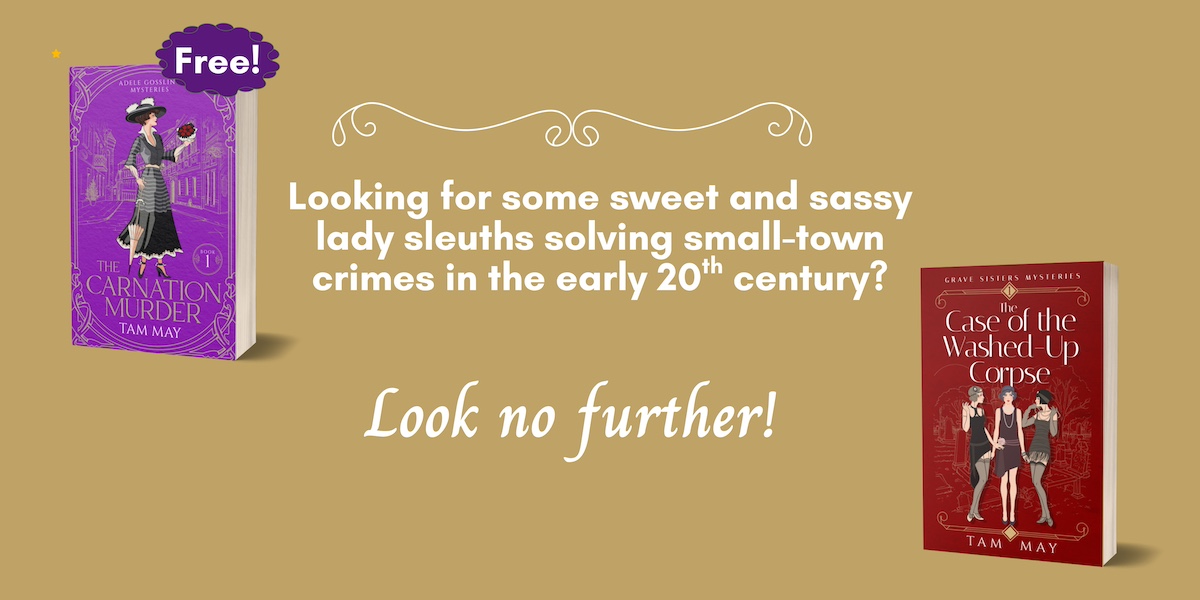
If you’re new to my site and haven’t yet checked out the Adele Gossling Mysteries, I encourage you to do that too! Book 1 of that series, The Carnation Murder, is free on all bookseller sites so you lose nothing but picking up a copy. You can find all the links here

If you love fun, engaging mysteries set in the past, you’ll enjoy The Missing Ruby Necklace! It’s available exclusively to newsletter subscribers here. By signing up, you’ll also get news about upcoming releases, fun facts about women’s history, classic true-crime tidbits, and more!

instagram
Facebooktwitterredditpinterestmail

Release Day Blitz for Adele Gossling Mysteries Box Set: Books 1-3!

Facebooktwitterredditpinterestmail

Title: Adele Gossling Mysteries Box Set 1: Books 1-3 (Adele Gossling Mysteries Box 

Series: Adele Gossling Mysteries

Author: Tam May

Genres: Historical Cozy Mystery

Release Date: November 25, 2023

Can a forward-thinking woman help the police solve crimes in a backward-thinking town?

“Great new series!”

Smart, inquisitive, and a firm believer in Progressive Era reforms, Adele Gossling seeks a new life after the devastating death of her father. She flees San Francisco for the town of Arrojo, planning a life of peace and small pleasures. But both elude her when she and her spiritual sidekick, Nin Branch, get involved in helping the local police solve the case of a dead debutante, a poisoned schoolteacher, and a family matriarch who may or may not have left a generous will.

The Carnation Murder: Adele Gossling has barely been in Arrojo for a week when she discovers her neighbor’s dead body in her gazebo. Can Adele and Nin solve this puzzling case involving a striped carnation, a diamond ring, a note, a muddy pair of boots, and a broken promise?

A Wordless Death: Millie Gibb, the new teacher at the local girl’s school, is found dead and everybody in town assumes the homely, unmarried spinster committed suicide. Can Adele and her clairvoyant friend Nin prove Millie’s death was foul play based on a cigar stub, a letter fragment, and a cigarette lighter before the case is closed for good?

Death at Will: When the affluent Thea Marsh dies unexpectedly, the trail of suspects leads to Thea’s beloved and favored eldest son, Theo. Will Adele make a case against Theo’s guilt for the police out of a stained teacup, a fountain pen nib, ashes that should have been in the fireplace, and daisies that should have been fresh?

Pick up this box set of the first three Adele Gossling Mysteries and immerse yourself in turn-of-the-century Northern California in all its dynamic and chaotic glory for a fun and cozy read!

You can get your copy of this box set at a special price at the following online retailers.


About the Author

Writing has been Tam May’s voice since the age of fourteen. She writes stories set in the past that feature sassy and sensitive women characters. Tam is the author of the Adele Gossling Mysteries which take place in the early 20th century and features suffragist and epistolary expert Adele Gossling whose talent for solving crimes doesn’t sit well with the town’s more conventional ideas about women’s place. She has also written historical fiction about women breaking loose from the social and psychological expectations of their era. Although Tam left her heart in San Francisco, she lives in the Midwest because it’s cheaper. When she’s not writing, she’s devouring everything classic (books, films, art, music) and concocting yummy plant-based dishes.


Social Media Links

Facebook: https://www.facebook.com/tammayauthor/

Instragram: https://www.instagram.com/tammayauthor/

Pinterest: https://www.pinterest.com/tammayauthor/ 

Amazon Author Page: https://www.amazon.com/Tam-May/e/B01N7BQZ9Y/ 

BookBub Author Page: https://www.bookbub.com/authors/tam-may

Goodreads Author Page: https://www.goodreads.com/author/show/16111197.Tam_May

instagram
Facebooktwitterredditpinterestmail