Love Hurts: Vinegar Valentines

Facebooktwitterredditpinterestmail

I am a huge Stevie Nicks/Fleetwood Mac fan (what can I tell you? I grew up in the 1970s and 1980s). One of the well-known facts about Fleetwood Mac’s bestselling album Rumours is that many of the songs were written in reaction to the multiple break-ups that were happening with the band members at the time. The most famous was between Stevie Nicks and Lindsey Buckingham. But the other members were also going through their own heartbreak. Christine and John McVie were getting divorced and drummer Mick Fleetwood was separated from his wife at the time. If you’re super curious, read this article for more about how souring relationships influenced this brilliant album.

But giving someone the brush-off via written verse started way before Fleetwood Mac. It dates back to the 19th century with what we now call “vinegar Valentines.”

Photo Credit: Vinegar Valentine: The Suffragette, 1919, John Hopkins University Women’s Suffrage Collection: Special Collections at John Hopkins/Flickr/CC BY NC ND 2.0 DEED

What are vinegar Valentines? We all know Valentine’s Day cards express love and devotion, right? Vinegar Valentines were completely the opposite. These little bombs either told off a past or present suitor or discouraged a would-be suitor from pursuit.

This form of valentine became very popular in the 19th and early 20th century with the rise of the written form in the United States (which is one reason why the protagonist of my Adele Gossling Mysteries series is a stationery store owner and epistolary expert). Since there was no email or text messaging at the time, people communicated through letters, postcards, and other written forms. So Valentine’s Day cards became another form of communication. 

In general, these valentines were meant to be more comic and sassy. However, their message could range from light comedy to downright aggressive. Not surprisingly, many of these vinegar Valentines were sent anonymously so the sender would never suffer the repercussions of his or her vicious message.

Just how bad were they? You can judge for yourself by checking out the slider (about a third of the way down the page) on this page

One of the main targets of these vinegar Valentines was suffragists. Women who fought for the right to vote were, in the eyes of many Victorian men (and, sadly, some women) “unfeminine” and “unwomanly” so who could be more fitting to receive the vinegar message on the day that represents love and courtship (which puts women firmly in the separate spheres) than women who believed they and other women should transcend the barriers of love and marriage?

Thankfully, vinegar Valentines began to fall out of fashion after World War I, and today we rarely see Valentine’s Day cards that are more than mildly annoying in their sense of humor. 

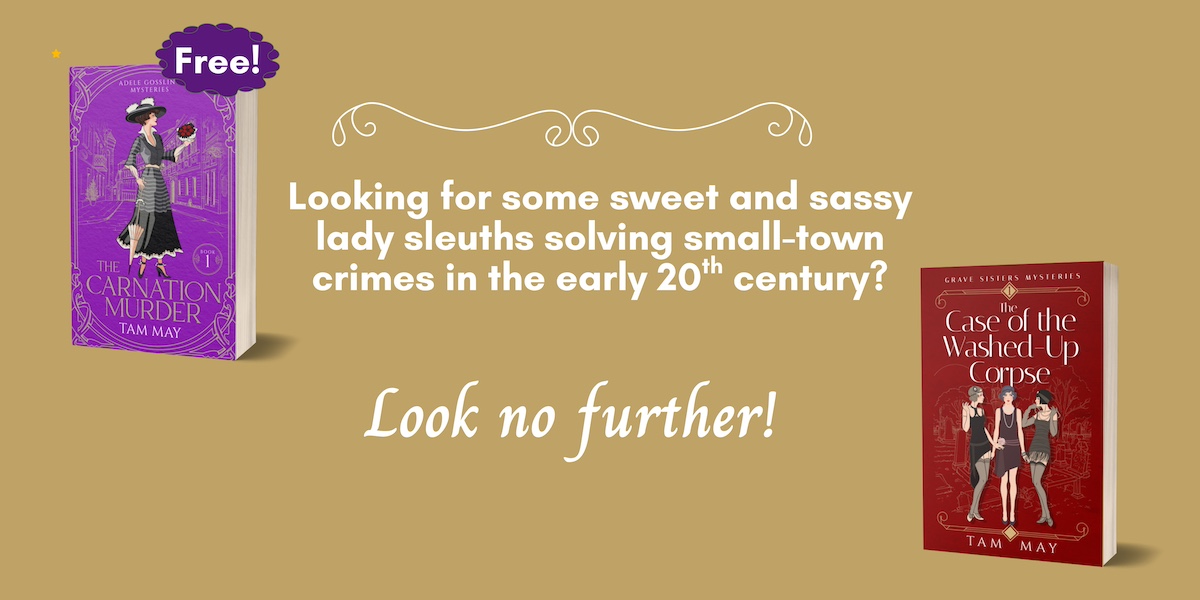
If you want to read how Adele uses her epistolary expertise to help the police of Arrojo solve crimes, look no further than Book 1, The Carnation Murder. It’s free on all bookstore sites! Check out this page for more about the book and links where you can download it.

If you love fun, engaging mysteries set in the past, you’ll enjoy The Missing Ruby Necklace! It’s available exclusively to newsletter subscribers here. By signing up, you’ll also get news about upcoming releases, fun facts about women’s history, classic true-crime tidbits, and more!

instagram
Facebooktwitterredditpinterestmail

Introducing the Grave Sisters Mysteries Series!

Facebooktwitterredditpinterestmail

If you’ve been subscribing to my newsletter (and if you haven’t, you might want to check out the link below because you’ll get a bunch of cool stuff, including a couple of freebies) you know I announced last year that I would be working on a new series in 2024 to launch in 2025. I’m now ready to talk a little bit about that new series.

The Grave Sisters Mysteries is going to be another historical cozy mystery series (like my Adele Gossling Mysteries). The two series have several elements in common. They both feature strong women sleuths who defy the conventions of their time. They are both set in small towns in California and they both include women who help men in law enforcement solve crimes. 

But the Grave Sisters Mysteries has a few differences that set it apart from my current series. As the name suggests, there is more than one sleuth in this new series. The sleuths, in fact, are three sisters. Eve is the oldest and most involved in solving the crimes. The middle sister, Helena, is her aide and brings different skills to the table. Their younger sister, Violet, is less involved in crime solving (at least at the beginning) but she nevertheless puts her hand in.

Another thing that makes the Grave Sisters Mysteries different from the Adele Gossling Mysteries is the sleuths’ non-crime-solving occupation. Adele runs her own stationary store in town. The Grave Sisters own a family business and its nature might surprise you. They run the only mortuary in town! That’s right. They deal with dead bodies in their line of work, though most of them get that way from natural causes rather than murder. Eve handles the administrative and accounting side of things while Helena is the resident mortician who prepares the bodies for burial. Violet, who is only eighteen in the first book, doesn’t get as involved in the family business until much later.

The time frames for both series are also different. Those who know the Adele Gossling Mysteries know the first book is set only a few years after the turn of the 20th century and the series is currently up to the middle of its first decade (spoiler alert: Book 7 is going to take place during the 1906 San Francisco Earthquake and Fire). Adele’s values and ideas fit the Progressive Era and her New Woman status lends interest and background to the mysteries.

The Grave sisters live in a later era. The first book is set in 1921, a period in American history that was just as vibrant as the Progressive Era, though in a different way. World War I  was behind us but the Roaring Twenties wasn’t exactly in full swing. In fact, the nation was experiencing a sort of dip in prospects with so many World War I veterans who returned home to find they couldn’t get jobs (this becomes one of the themes of Book 2 of this series). But the sisters are firmly planted in this era that was experiencing a transition from the old to the new. America was still trying to hold on desperately to its old values and yet, the younger generation was sick and tired of the old ways and bringing in the modern age against their parents’ and grandparents’ resistance. All of these things affect the sisters and their relationship to one another. Future blog posts will address some of these topics. 

Even though Book 1 of the Grave Sisters Mysteries won’t be released until the spring of 2025, don’t despair! I have more information for you about the series here. Book 1 will be available for preorder sometime later this year. I’ll also be including more updates about this series as well as details and excerpts in my newsletter this year, so if you’re not signed up for my newsletter, now is a great time to do so!

If you’re new to my site and haven’t yet checked out the Adele Gossling Mysteries, I encourage you to do that too! Book 1 of that series, The Carnation Murder, is free on all bookseller sites so you lose nothing but picking up a copy. You can find all the links here

If you love fun, engaging mysteries set in the past, you’ll enjoy The Missing Ruby Necklace! It’s available exclusively to newsletter subscribers here. By signing up, you’ll also get news about upcoming releases, fun facts about women’s history, classic true-crime tidbits, and more!

instagram
Facebooktwitterredditpinterestmail

Historical Christmas Traditions

Facebooktwitterredditpinterestmail

I recently started teaching English to students from all over the world and one of the things I love to hear from them is about their holiday traditions. I was surprised to hear from a student of mine that she celebrates Christmas in mid-January and her traditions are more focused on the religious aspect of Christmas than gift-giving (although her family exchanges plenty of gifts too!)

In America, Christmas traditions haven’t changed much. Love it or hate it, Christmas in America has been big business since the Gilded Age and Progressive Era. The late 19th and early 20th centuries were filled with opulence, glamour, and progress. There was nothing that couldn’t be packaged and sold to the American public, and holidays were at the top of the list.

Before the late 19th century, ornaments on the Christmas tree were pretty simple. The tradition of Christmas tree decorations was brought over by German settlers in the 1830s, but Gilded Agers turned it into something much more elaborate. The word “modesty” was not in the vocabulary of the era. Gilded Agers loved sparkle and shine and they weren’t afraid to make a profit from it. They turned the decorations of simple strings of popcorn and beads of past decades into displays of lights, colored glass balls, and wax angels. Christmas tree ornaments became a big commercial enterprise during this time, replacing these homemade ornaments.

Photo Credit: Christmas card by Louis Prang, showing a group of anthropomorphized frogs parading with a banner and band. 19th century (no specific date), American Antiquarian Society. M2545/Wikimedia Commons/PD Old 100 

The humble Christmas card also acquired a different meaning in the late 19th and early 20th centuries. Louis Prang, one of the most successful printers of this era, began producing Christmas cards with a dream in mind: to create mini lessons in fine art for people on a budget. He saw his cards as artistic achievements even the working class could afford. But this idea of democratizing fine art was not one Gilded Agers were yet willing to embrace. They were, however, happy to take the idea of the Christmas card and make it more illustrative and attractive to buyers. Prang’s idea of elevating Christmas cards to art fell by the wayside but it started a trend with other illustrators producing cheaper variations. However, as this article shows, they were still quite beautiful.

The gift-giving that now dominates today’s Christmas commercials on TV and online became big business during this time as well. It was an opportunity to show one’s generosity with elaborate and expensive gifts. Wrapping presents was also a Gilded Age invention, as it fits in with the idea of garnish presentation that characterized the age. Plain white wrapping paper said something unpleasant about what the giver could afford, but elaborate wrapping paper told loved ones the gift came from the “right” places.

Photo Credit: Merry Old Santa Claus, Thomas Nast, 1 January 1881, Harper’s Weekly: Soerfm/Wikimedia Commons/PD Art (PD Old 100)

We think of Santa as a jovial and white-bearded man bestowing presents to “good” little boys and girls. But in the early 20th century, Santa had political and social implications. Santa was the glorified symbol of Capitalism with a capital “C”, an authoritative and somewhat mystical figure who held gifts aplenty — for those who deserved them, of course. The deserved ones were judged not by their goodness but by their political beliefs or their support of Capitalism.

Why not treat yourself to some fiction from the past that features women who don’t just take the confines of their era lying down? You can start with two free books! The first book of my Adele Gossling Mysteries is free on every online bookstore and so is the first book of my Waxwood Series. You can get  The Carnation Murder here and The Specter here

If you love fun, engaging mysteries set in the past, you’ll enjoy my novella The Missing Ruby Necklace! It’s available exclusively to my newsletter subscribers and you can get it here. By signing up, you’ll also get news about upcoming releases, fun facts about women’s history, classic true-crime tidbits, and more!

instagram
Facebooktwitterredditpinterestmail

Trailblazers: Lady Lawyers in the 19th Century

Facebooktwitterredditpinterestmail

Book 3 of my historical cozy mystery series the Adele Gossling Mysteries, introduces a new character into the small town of Arrojo. Rebecca Gold is a lawyer who has come to town to open her own practice after having been treated like a clerk rather than a lawyer in the big city law firms where she worked. 

How common were women lawyers in the 19th and early 20th centuries? As you might imagine, not that common. The separate spheres made it difficult for women to venture outside the private sphere of home, family, and church. The law, being one of the most public spheres out there (right alongside politics and business) was, therefore, largely off-limits. 

But there were a few who did brave the social and sometimes legal limits to study law. The first of these was Arabella Mansfield. In 1869, she became the first woman lawyer in America. Although her home state of Iowa forbade women to take the bar exam, Mansfield defied this practice and took it anyway. Her very high marks swayed Iowa legislation to relax these laws and allow women to take the bar exam. Mansfield became an apprentice at her brother’s law firm early on during her studies. However, once she passed the bar exam, she decided to forgo law for activism and education, including suffragism.

Alongside her was Ada Kepley who, in 1870, earned her law degree from Northwestern University. However, her home state of Illinois also didn’t allow women to take the bar exam and, unlike Iowa, Illinois legislation wasn’t budging on this. So Kepley was unable to actually make use of her law degree. Kepley did eventually take the bar exam in 1881 and passed but, like Arabella Mansfield, chose to use her experience and knowledge for activism, particularly temperance and — you guessed it — women’s suffrage.

Photo Credit: Drawing of Charlotte E. Ray, before 1911, unknown author: Gobonobo/Wikimedia Commons/PD US

And let us not forget Charlotte E. Ray who was the first African American woman to practice law. She received her law degree in 1872 and was admitted to practice law in the District of Columbia Supreme Court. Unlike Mansfield and Kepley, however, Ray did eventually open her own office, specializing in corporate law. Sadly, she only kept her doors open for a few years, as racial prejudice made gaining a steady clientele difficult. She took her knowledge and experience and became a teacher, focusing on education and later, women’s suffragism.

You’ll notice a pattern here: these three women either never put their law degree to use or they only practiced for a very short time. Why? I’m sure mistrust of women in so lucrative a field had something to do with it (and we know in Charlotte E. Ray’s case, there was added racial prejudice). Maybe it was also that the time and dedication needed to practice law made it difficult for these women to juggle both the public and the private spheres (since we might assume they also had the duties of the home on their shoulders whereas a male lawyer was largely exempt from that). Or maybe it was just the ideologies of the separate spheres die hard, even for progressive women. 

In my book, however, Rebecca Gold is a practicing lawyer and her first case gets her in plenty of hot water. Find out how in Death At Will, the third book of the Adele Gosslnig Mysteries. And how about Books 1 and 2? Well, you can pick up all three books in a lovely box set at a great price here

If you love fun, engaging mysteries set in the past, you’ll enjoy my novella The Missing Ruby Necklace! It’s available exclusively to my newsletter subscribers and you can get it here. By signing up, you’ll also get news about upcoming releases, fun facts about women’s history, classic true-crime tidbits, and more!

instagram
Facebooktwitterredditpinterestmail

Release Day Blitz for Adele Gossling Mysteries Box Set: Books 1-3!

Facebooktwitterredditpinterestmail

Title: Adele Gossling Mysteries Box Set 1: Books 1-3 (Adele Gossling Mysteries Box 

Series: Adele Gossling Mysteries

Author: Tam May

Genres: Historical Cozy Mystery

Release Date: November 25, 2023

Can a forward-thinking woman help the police solve crimes in a backward-thinking town?

“Great new series!”

Smart, inquisitive, and a firm believer in Progressive Era reforms, Adele Gossling seeks a new life after the devastating death of her father. She flees San Francisco for the town of Arrojo, planning a life of peace and small pleasures. But both elude her when she and her spiritual sidekick, Nin Branch, get involved in helping the local police solve the case of a dead debutante, a poisoned schoolteacher, and a family matriarch who may or may not have left a generous will.

The Carnation Murder: Adele Gossling has barely been in Arrojo for a week when she discovers her neighbor’s dead body in her gazebo. Can Adele and Nin solve this puzzling case involving a striped carnation, a diamond ring, a note, a muddy pair of boots, and a broken promise?

A Wordless Death: Millie Gibb, the new teacher at the local girl’s school, is found dead and everybody in town assumes the homely, unmarried spinster committed suicide. Can Adele and her clairvoyant friend Nin prove Millie’s death was foul play based on a cigar stub, a letter fragment, and a cigarette lighter before the case is closed for good?

Death at Will: When the affluent Thea Marsh dies unexpectedly, the trail of suspects leads to Thea’s beloved and favored eldest son, Theo. Will Adele make a case against Theo’s guilt for the police out of a stained teacup, a fountain pen nib, ashes that should have been in the fireplace, and daisies that should have been fresh?

Pick up this box set of the first three Adele Gossling Mysteries and immerse yourself in turn-of-the-century Northern California in all its dynamic and chaotic glory for a fun and cozy read!

You can get your copy of this box set at a special price at the following online retailers.


About the Author

Writing has been Tam May’s voice since the age of fourteen. She writes stories set in the past that feature sassy and sensitive women characters. Tam is the author of the Adele Gossling Mysteries which take place in the early 20th century and features suffragist and epistolary expert Adele Gossling whose talent for solving crimes doesn’t sit well with the town’s more conventional ideas about women’s place. She has also written historical fiction about women breaking loose from the social and psychological expectations of their era. Although Tam left her heart in San Francisco, she lives in the Midwest because it’s cheaper. When she’s not writing, she’s devouring everything classic (books, films, art, music) and concocting yummy plant-based dishes.


Social Media Links

Facebook: https://www.facebook.com/tammayauthor/

Instragram: https://www.instagram.com/tammayauthor/

Pinterest: https://www.pinterest.com/tammayauthor/ 

Amazon Author Page: https://www.amazon.com/Tam-May/e/B01N7BQZ9Y/ 

BookBub Author Page: https://www.bookbub.com/authors/tam-may

Goodreads Author Page: https://www.goodreads.com/author/show/16111197.Tam_May

instagram
Facebooktwitterredditpinterestmail