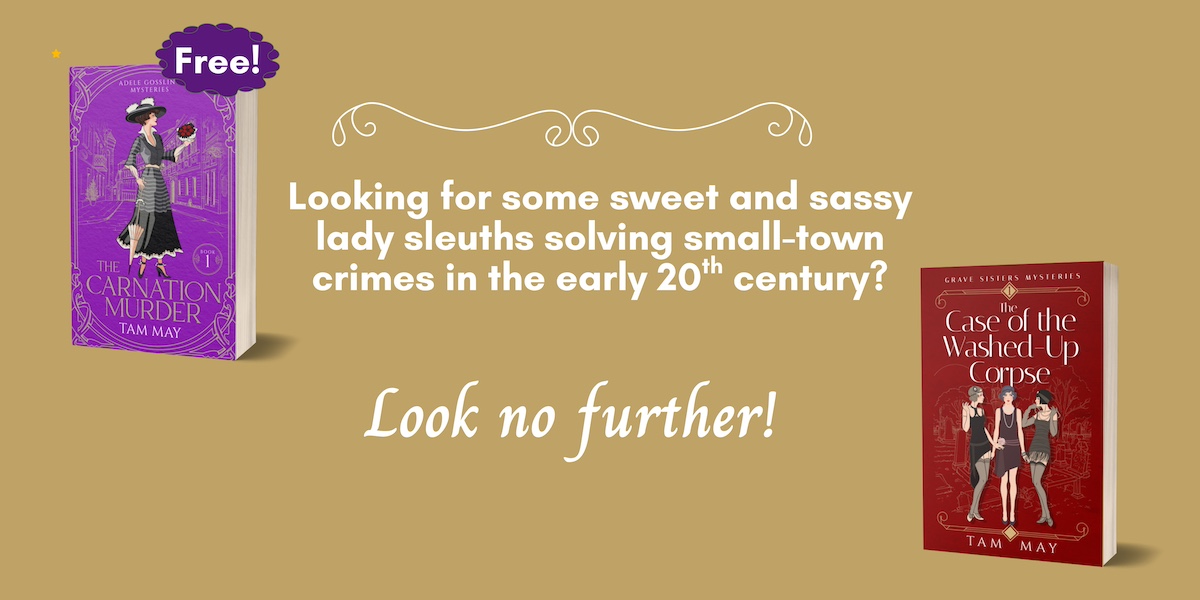
Release Day Blitz for The Carnation Murder!

Facebooktwitterredditpinterestmail

Title: The Carnation Murder

Series: Adele Gossling Mysteries (Book 1)

Author: Tam May

Genres: Historical Cozy Mystery

Release Date: April 30, 2022

California, 1903: Smart, inquisitive, and a firm believer in the new progressive reforms, Adele Gossling seeks a new life after the devastating death of her father. She flees San Francisco for the small town of Arrojo, planning a life of peace and small pleasures with nothing more exciting than selling fountain pens to the locals in her stationery shop and partaking in the town’s favorite pastime: gossip.

Peace is exactly what she doesn’t get when she discovers her neighbor’s dead body in her gazebo. The police think they have a firm suspect: the young man who was secretly engaged to the victim. But Adele and her clairvoyant new friend Nin Branch are sure he’s innocent. In spite of the raised eyebrows from Arrojo’s Victorian-minded citizens, they set out to prove the young man didn’t do it. But if he didn’t, who did?

Can Adele and Nin solve this puzzling case involving a striped carnation, a diamond ring, a note, a muddy pair of boots, and a broken promise? 

You can get your copy of the book at a special promotional price from your favorite online book retailer here.

Excerpt

James showed them into the ballroom. 

“I can’t imagine what you think you’ll find, Sheriff,” Adele remarked. “The servants cleared every morsel of the party ages ago.”

“One can never tell.” He examined the floor. “We already know the body was dragged from somewhere. It could have easily been from some hidden corner in this house.”

“In a house this size, it’s entirely possible,” Jackson agreed.

“I beg your pardon, sir.” James cleared his throat. “Mr. Blackstone was most particular about people straying too far from the ballroom. For young Mickey’s sake.”

“Young boys are always afraid of missing all the excitement,” Jackson said ruefully.

“He particularly asked the servants to redirect anyone who wandered past the hallway,” James continued.

“But Mr. and Miss Gossling said they saw some people going out the back door.”

“Yes, sir,” said the man. “It leads to the veranda. Mr. Blackstone had no objection to guests going out for a bit of fresh air.”

“Can you show us?” 

James led them to the hall and opened the back door. The lace curtains seemed limper than they had been a few nights before. Japanese paper lanterns were still strung up, though not lit.

“It must have been quite a spectacle out here,” The sheriff remarked, eyeing them.

“We wouldn’t know,” said Jackson. “Neither Adele nor I ventured outside.”

“Quite content to watch the intrigues going on inside, eh?” Hatfield eyed him.

“Quite.” Jackson’s voice was guarded. “If Lucy was killed out here and dragged, there would be a mark somewhere.”

“I scarcely think it’s possible that she was killed here, Sheriff,” said Adele. 

“And why is that?”

“The lights.” She steadied a swinging lantern with her parasol. “They would have illuminated even the slightest movement. The curtains were drawn in the ballroom and as you can see, that room overlooks this part of the veranda.”

“I see you and your brother both inherited strong powers of observation,” said Hatfield with a gleam in his eye.

About the Author

As soon as Tam May started writing when she was fourteen, writing became her voice. She writes engaging, fun-to-solve historical cozy mysteries. Her mysteries empower readers with detailed plots and a sense of “justice is done” at the end. Her fiction is set in and around the San Francisco Bay Area because she adores sourdough bread, Ghirardelli chocolate, and the area’s rich history. Tam’s current project is the Adele Gossling Mysteries. The series takes place in Northern California in the early 20th century and features amateur sleuth and epistolary expert Adele Gossling. Together with her clairvoyant friend, Nin Branch, they ensure justice is served for women, both living and dead. Tam lives in Texas but calls San Francisco and the Bay Area “home”. When she’s not writing, she’s reading classic literature, watching classic films, reading self-help books, or cooking yummy vegetarian dishes.

Social Media Links

Facebook: https://www.facebook.com/tammayauthor/

Instragram: https://www.instagram.com/tammayauthor/

Goodreads Author Page: https://www.goodreads.com/author/show/16111197.Tam_May

Amazon Author Page: https://www.amazon.com/Tam-May/e/B01N7BQZ9Y/ 

BookBub Author Page: https://www.bookbub.com/authors/tam-may

instagram
Facebooktwitterredditpinterestmail

America’s First Female Private Eye: Kate Warne

Facebooktwitterredditpinterestmail

Most Americans know the story of the Lincoln assassination on that fateful night at Ford’s Theater on April 15, 1865. Too bad Kate Warne wasn’t on the job. 

Who was Kate Warne? Only the first woman private detective, one of those women that history forgot. But as we’re wrapping up Women’s History Month, let’s take a peek at this amazing woman’s life.

Warne was a bold widow who, in 1856, walked into the Pinkerton Detective Agency and asked its founder, Allan Pinkerton, for a job. And not just any job. She asked for a job as a private detective. 

Keep in mind this was the era of the separate spheres. Women were delegated to the home, church, and family. They did not get involved in law and order. But Warne knew she could be a huge asset to the Pinterketons because she was a woman. Women were invisible beings at that time. No one paid much attention to what they said or did as long as they were respectable and didn’t rock the boat. So who better to do undercover work than a woman?

This is exactly what Warne did. Her first case was to get a confession out a Southern embezzler. She got it by taking a woman’s route: She befriended the man’s wife and circulated in society as a widow under the name of “Mrs. Cherry.”

Photo Credit: Kate Warne, watercolor portrait, cropped, 1866, unknown artist, Chicago History Museum: Benjamin.P.L./Wikimedia Commons/PD US Expired

Her biggest assignment came in 1861. The newly-elected Lincoln was traveling by train from Illinois to Washington for his inauguration when rumors of a plot to assassinate the newly elected president began circulating. Using her beauty and charm, Warne got in with the Southerners on the train, including secessionists, and learned the details of a plot to take Lincoln in Baltimore. She and Pinkerton himself helped Lincoln to get through Baltimore by disguising the president-elect and coveting him in a sleeping berth for the Baltimore leg of the trip. Her wiliness and womanliness saved Lincoln from assassination — that time.

Warne continued her undercover work during the Civil War, mainly as a spy who picked up information in Southern society and passed that information on to the Northern army. Her success as a private eye encouraged Pinkerton to continue hiring women for his agency, many of whom Warne supervised. Sadly, Warne’s work came to a premature end when she died in her mid-30s. 

My amateur sleuth, Adele Gossling, also uses her feminine wiles to help the police solve crimes. Unlike Warne, her status as a New Woman at the turn of the century gives her much more of a voice and a presence in the world. But she can wheedle information out of anyone, including a bumbling assistant deputy sheriff and a rough-edge cowboy named Rainer. 

To read all about that, pick up a copy of The Carnation Murder, Book 1 of the Adele Gossling Mysteries, now at 99¢, here

If you love fun, engaging mysteries set in the past, sign up for my newsletter to receive a free book, plus news about upcoming releases, fun facts about women’s history and mystery, and more freebies! You can sign up here

instagram
Facebooktwitterredditpinterestmail

Who was Miss Marple REALLY?

Facebooktwitterredditpinterestmail

We hear a lot about famous male sleuths like Sherlock Holmes, Charlie Chan, Father Brown, and, of course, Agatha Christie’s Hercule Poirot. They’ve become so famous that after Christie wrote the last Poirot book in 1975, The New York Times published Poirot’s obituary (if you don’t believe me, check this out). 

But until recently, we haven’t heard much about famous female sleuths. That’s because, before Maisie Dodd and Jessica Fletcher, there just weren’t that many around. If called upon to name a famous amateur female sleuth, most people would probably think of Agatha Christie’s Jane Marple.

Marple often gets forgotten in the Christie canon because Poirot was more famous. Given a few quirks, he fits the stereotype of the famous detective while Miss Marple sort of slips through the cracks. Marple is anything but typical of what we might think of as an amateur detective — elderly (Christie’s books hint she’s in her seventies), hedgy, and mild-mannered, with a tendency to ramble on about the little world of her hometown, St. Mary Mead. 

In one of his books on writing, crime author Lawrence Block confessed he likes Marple much more than Christie’s other famous detective, claiming she is more interesting and complex than Poirot. 

I’m a huge fan of the Poirot series, largely after binge-watching the hit British series Poirot (side note: If you’re a fan of Christie and have never seen this series, I highly encourage you to get hold of it. David Suchet nails the Poirot character in looks and mannerisms and really makes the character come alive). I’ve read a few of the Marple books and, to be honest, Miss Marple didn’t impress me. Her wishy-washiness and tangents about St. Mary Mead just got on my nerves. Nevertheless, I could see what Block was talking about. Underneath the grandmotherly countenance and knitting needles lurks a very shrewd and observant mind. 

Photo Credit: Margaret Rutherford as Jane Marple, Murder at the Gallop, 1963, taken 2 October 2006 by Mr. AEL: Mr. AEL/Flickr/CC BY NC ND 2.0

Actually, Marple wasn’t the first woman sleuth of advanced years. In fact, Christie took her inspiration for Marple from another not-so-young character who helped the police solve crimes. She was Anna Katharine Green’s Amelia Butterworth. Green was an American crime writer who wrote some years before the Golden Age of Crime Fiction. Green wrote three novels featuring Butterworth, with the first published in 1897. Butterworth is a Gilded Age creation, as, in spite of her age, she has the independent spirit and a gutsiness that would characterize the much younger generation of New Woman emerging at that time.

Interestingly, many film and TV versions of Miss Marple have tried to bring a little life into her beyond Christie’s rather limited vision of the elderly woman sleuth. Probably the most well-known of these was British actress Margaret Rutherford’s Marple. Although Rutherford’s Marple was always with her knitting needles, she looked more likely to poke somebody’s eyes out than make a sweater with them. Rutherford gives Marple the feminist “oomph” she needs, reminiscent of the earlier Butterworth. Although there were only four films made in the Marple series in the 1960s (and one of them was actually based on a Poirot book), they established the image of the lady sleuth we most often think of today — shrewd, tough, and taking no BS from anybody. 

How about some more women sleuths with “oomph”? Check out my new Adele Gossling Mysteries, launching on April 30. The first three books are up for preorder and the first is only 99¢. You can find out more here

If you love fun, engaging mysteries set in the past, sign up for my newsletter to receive a free book, plus news about upcoming releases, fun facts about women’s history and mystery, and more freebies! You can sign up here

instagram
Facebooktwitterredditpinterestmail

Cover Reveal/Release Day Announcement: The Carnation Murder

Facebooktwitterredditpinterestmail

Every year, I choose a word and/or phrase to define how I want to improve myself. This year, my phrase is “let it go”. I even have a card stuck on my bulletin board to remind me to let things go.

After five years of writing historical women’s fiction, I’m letting it go and turning to something new: historical cozy mysteries. Why? Because I realized who I am now is not who I was five years ago. Historical women’s fiction served me well at that time, and I loved writing the Waxwood Series. But now all I want to give readers is a sense of comfort and a little bit of fun. Nothing spells comfort and fun more than cozy mysteries. 

This is why I’m thrilled to present the cover for The Carnation Murder, the first book of my Adele Gossling Mysteries, and tell you when the book is coming out.

So, without further ado…

historical mystery, cozy mystery, women sleuth, new release, ebook, murder mystery, small town mystery

So, y’all probably notice there’s a lot of purple in there, right? There’s a reason for that. The color purple plays a role in helping Adele Gossling solve the mystery of the dead debutante in her gazebo. On a carnation, purple is about whimsy and freedom. How do these qualities appear in the book? You’ll have to read it to find out!

You’ll also notice the gold frame on the book. Originally, the fabulous designer who made the cover went for more of an Art Deco look, using geometric shapes and clean lines and spheres. A great example of Art Deco is these stills from the 1927 silent masterpiece Metropolis

As much as I love Art Deco, we associate it more with the 1920s and 1930s. The Adele Gossling Mysteries takes place at the turn of the 20th century, some twenty years earlier. So the designer and I went back and forth, and we finally decided on a more Art Nouveau style for the frame. Art Nouveau was sort of the precursor to the Art Deco movement, combining the favored lines and spheres with a more decorative and florid style. One of the defining artists of this period was Alphonse Mucha, whose work you can see here

Here’s more about The Carnation Murder:

Smart inquisitive, and a firm believer in the new progressive reforms, Adele Gossling seeks a new life after the devastating death of her father. So she flees the big city of San Francisco for the small town of Arrojo. She plans a life of peace and small pleasures running her own stationery shop and living in her own house. But peace is exactly what she doesn’t get when she discovers her neighbor dead in her gazebo. The police think they have a firm suspect: the young man who was secretly engaged to the victim. But Adele and her clairvoyant new friend Nin Branch suspect the young man is innocent. In spite of the raised eyebrows from Arrojo’s Victorian-minded citizens, she and Nin set out to prove Richard Tanning didn’t do it. But if he didn’t, who did?

What early reviewers are saying:

“Really well paced and researched appropriately for the era.”

“The story comes alive.”

Release Date: April 30, 2022

I’m equally excited to let you know the book is now on preorder at a very special price. So come check it out and get your copy at your favorite online bookstore here

Happy reading!

instagram
Facebooktwitterredditpinterestmail

This Month’s Woman in History: Nannie Helen Burroughs

Facebooktwitterredditpinterestmail

Photo Credit: Nannie Helen Burroughs, 1909, Library of Congress Prints and Photographs Division: FloNight/Wikimedia Commons/PD US 

For women to take on the entrepreneurial spirit in the 21st century is not only accepted but supported. Women business owners have a lot of resources online and in their communities these days to help them build and grow their businesses in whatever field they choose. When they can’t get the job they want, they create it.

But in the early 20th century, this wasn’t the case. In spite of the rise of the suffragist movement during this period, ideas about women’s place were still hampered by the previous century’s separate spheres. Even progressive women like Adele Gossling, the protagonist of my new series, The Adele Gossling Mysteries, is looked down upon by the inhabitants of her new home because she prefers running her stationery store and helping the police solve crimes over marriage and children.

One woman who took the entrepreneurial spirit to new heights and opened many doors for African-American women at the turn of the century was Nannie Helen Burroughs. The daughter of former slaves, Burroughs took her high scholastic achievements and applied for a job with the Washington D.C. public school system. She didn’t get it. So, like many women entrepreneurs, she decided to create the job she wanted. Her dream was to open her own school for girls that would teach them how to make their own living and give them the courage, strength, and education to fight for the rights of their people. 

Burroughs began putting her plan into action by doing what many women entrepreneurs do: She worked at odd jobs to save up money to build her school. She solicited all the funds she could from the African-American community, refusing to accept donations from whites so she could dictate the curriculum of her school in her way. When she bought the buildings and land for her school, she did much of the work herself. She opened the doors to the National Training School for Women And Girls in 1909 and from the get-go, it was a huge success.

Photo Credit: Trades Hall, National Training School for Women and Girls, now the headquarters of the Progressive National Baptist Convention, taken by Farragutful on 8 July 2017: Farragutful/Wikimedia Commons/ CC BY SA 4.0 

Burroughs’ ideas of women’s education were progressive for her time. Like many New Women, she believed the sky was the limit to what girls could and should learn. At the same time, her school emphasized the importance of practical training so her girls would graduate with the skills to support themselves. The curriculum included courses in dressmaking and handicrafts along with literature and science. Like many New Women, Burroughs also believed in physical activity for girls, abhorring the previous century’s “delicate woman” and the school had its own basketball team. 

Burroughs’ school evolved with the times, such as teaching skills relevant to women seeking work in factories during World War II. Upon her death in 1961, the National Training School for Women and Girls was renamed the Nannie Helen Burroughs School. Today, the six-acre complex houses several facilities, including the headquarters of the Progressive National Baptist Convention, a group that works for civil rights and social justice, and a private high school.

Let’s celebrate this amazing woman educator, suffragist/feminist, and civil rights activist during this Black History Month!

If you love fun, engaging mysteries set in the past, you’ll enjoy The Missing Ruby Necklace! It’s available exclusively to newsletter subscribers here. By signing up, you’ll also get news about upcoming releases, fun facts about women’s history, classic true-crime tidbits, and more!

instagram
Facebooktwitterredditpinterestmail