Boston Marriages and The New Woman

Facebooktwitterredditpinterestmail

This month is LGBTQ+Pride month so let’s talk about Boston marriages. 

These were not really marriages (that is, legally) and they weren’t always in Boston. The term came from Henry James’ novel The Bostonians, published in 1886. This book (made into a film almost 100 years later starring Vanessa Redgrave and Christopher Reeve) tells the story of women’s suffrage and the New Woman from a man’s point of view. In it, the very prim and proper spinster Olive takes under her wing a free-spirited, charismatic speaker named Verena with the intent of educating her and grooming her as a leader of the suffragist movement. Their affectionate and mutually respectful relationship is challenged by Olive’s Southern cousin, a Civil War veteran who is not exactly a believer in women’s lib.

James’ novel is set in Boston and depicts the Olive/Verena relationship as a kind of intellectual marriage of minds — hence, Boston Marriage. But Olive and Verena’s relationship wasn’t exclusive to fiction. In fact, James took the model for their relationship from his own sister. Alice James lived in a Boston Marriage with her companion Katharine Loring for almost twenty years.

Photo Credit: Alice James (reclining) and her companion Katharine Loring, 1890, Royal Leamington Spa in England, unknown source, unknown author: Elisa.rolle/Wikimedia Commons/PD Old 70 expired

To understand the appeal of Boston Marriages, we want to go back to the philosophy of the separate spheres that dominated the 19th and early 20th centuries. Women were confined to a very small space and expected to remain there, physically, mentally, and intellectually. Women who had intelligence, wit, and charisma were oftentimes encouraged not to express it, and those who did have the courage to be themselves were oftentimes ridiculed and mocked.

Women who entered a Boston Marriage, which means they created a domestic partnership where they shared a home, finances, and an emotionally attached relationship, sought to be respected and revered for their intelligence. It was no wonder many of them were New Women, as the ideals and values of New Women fit in with the Boston Marriage perfectly. These were women who were independent in mind and spirit, usually financially well off (so they didn’t need a man to support them), educated, and intellectually curious. They knew they had a lot to give and chose to give it to a female partner instead of a male one.

The question debated for years about these domestic arrangements is: Were they lesbian relationships too? Many say there is evidence from passionate correspondences that many did have a sexual component. However, one thing to remember is the line between romance and friendship wasn’t as tightly drawn in the 19th century as it is in the 21st. If you look at letters written between women friends, and even men friends, during this period, you’ll likely find language we would consider appropriate only for a romantic partner nowadays. So romantic language was not always evidence of romance during this time. 

The likely answer to this question is: Some of the relationships were sexual and some were platonic, and because of the taboo put on same-sex love in the 19th and early 20th centuries, we’ll probably never know which ones were and which ones weren’t. 

Boston Marriages were one way out of the conventional path for many intelligent and independent women. They had the companionship they deserved and were able to pursue their own values without being expected to behave in certain ways that they found constricting and inauthentic to them.

Between Adele Gossling, my protagonist for the Adele Gossling Mysteries, and Nin Branch, her sidekick, there exists not a Boston Marriage (Adele lives with her brother while Nin prefers to live on her own) but the same respect and reverence for women’s intelligence and wit. Each woman honors the strengths of the other and encourages her in her talents. They give one another emotional support and comfort throughout the series, especially when faced with the more restrictive mindsets of men like Jackson, Adele’s brother, and the county sheriff.

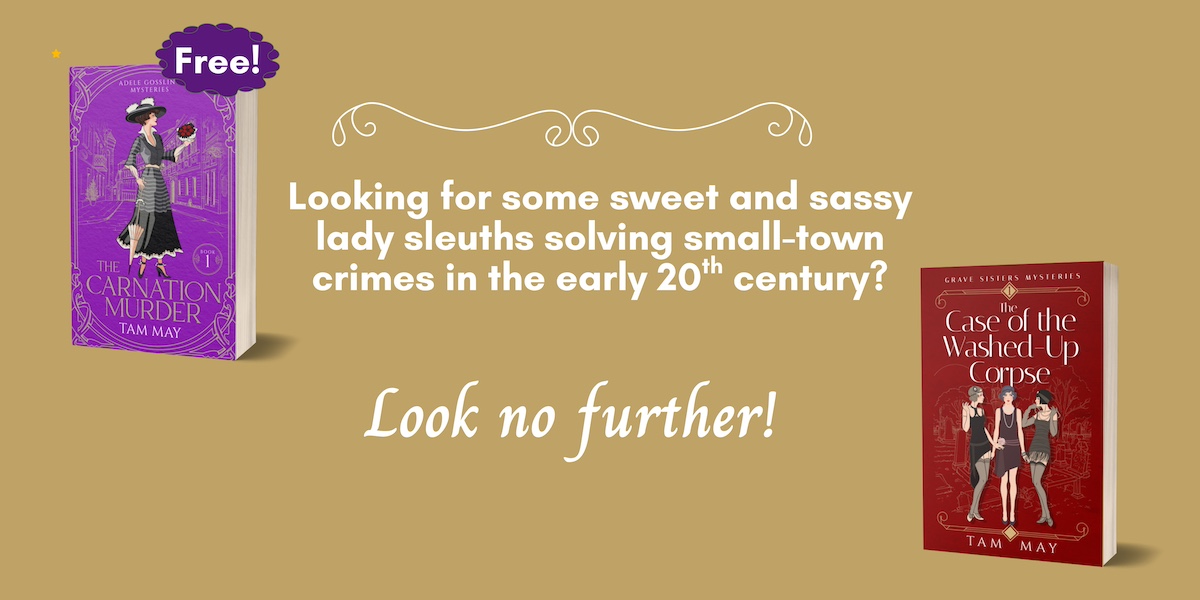
Book 1 of the Adele Gossling Mysteries is out and you can pick it up here at a special price. And don’t forget to check out Book 2 of the series, which is now on preorder also at a special price!

If you love fun, engaging mysteries set in the past, sign up for my newsletter to receive a free book, plus news about upcoming releases, fun facts about women’s history and mystery, and more freebies! You can sign up here

instagram
Facebooktwitterredditpinterestmail

The Man Who Brought Down Al Capone

Facebooktwitterredditpinterestmail

Did you know May is National Mystery Month? 

Today, May 4, marks a milestone in American criminal history. On this day in 1931, one of the most ruthless and famous crime bosses of the Prohibition Era, Al Capone, began serving his 11-year prison sentence for tax evasion.

America has always had a bee up its bonnet about liquor and in some ways, still does (I live in a county that was a “dry” county — i.e., no selling liquor within county lines — until 1999). Temperance was high on the list of reforms during the Progressive Era. After World War I, the nation’s government decided to do something about it. So in 1919, the Volstead Act was passed, prohibiting the making and selling of liquor in America. In 1920, the Prohibition Era kicked off in America, bringing with it the birth of the gangster, the speakeasy, and the Tommy gun. It also marked the most violent era in criminal history in America.

I meant to write this blog post about the criminal (Al Capone). But digging deeper into the history of Prohibition law enforcement, I became more fascinated by the crime fighters than the criminal. Because there was a team of crimefighters that brought down Capone and they were led by one man: Eliot Ness. 

Photo Credit: Eliot Ness, 1933, retouched: Melesse/Wikimedia Common/PD US government

Ness worked for the federal government and he and his men had a reputation for being smart, heroic, and incorruptible (no mean feat during this era). He worked for the ATF (Alcohol, Tobacco, and Firearms) department which put the fight to enforce anti-liquor laws right up his alley. In 1930, his department paired with the U.S. Department of Justice and Treasury in the fight against violent crimes in America which had reached their peak. That year was also Hoover’s declaration of war against the gangsters largely responsible for those crimes. At the head of the list was Al Capone, who had risen to fame as Chicago’s kingpin and evaded every criminal accusation made against him.

The message was clear: get Al Capone on something, anything. Agents worked several angles, including the (obviously) prohibition violation angle and the income tax evasion angle. In the end, the treasury won. Though Ness and his team managed to get enough evidence together to bring forth thousands of prohibition violations against Capone, the kingpin eventually was sent to jail not for the many people he had killed and the violence he and his gang instigated but for avoiding his income taxes.

Why was Capone found guilty of tax evasion rather than prohibition violations (those charges were eventually dropped?) One theory is prosecutors were afraid the jury would find Capone not guilty of the violation charges because, frankly, everybody hated prohibition, and many saw gangsters that fought against it as heroes rather than criminals. Tax evasion, though, was a different matter. Most citizens weren’t sympathetic to those who didn’t pay their taxes (just as we are today). Keep in mind Hoover’s orders: get Al Capone on anything. 

Still, Ness made his mark in history. In fact, he was so well known during this era that in that same year, cartoonist Chester Gould created a tough-talking, smart private eye who would become an icon in detective fiction. 

Come meet the crime fighters of my Adele Gossling Mysteries, starting with Book 1, The Carnation Murder, which is out now and at 99¢ (though not for much longer!) You can get all the details about the book Barnes & Noble chose for their Top Indie Favorites list here

If you love fun, engaging mysteries set in the past, sign up for my newsletter to receive a free book, plus news about upcoming releases, fun facts about women’s history and mystery, and more freebies! You can sign up here

instagram
Facebooktwitterredditpinterestmail

Release Day Blitz for The Carnation Murder!

Facebooktwitterredditpinterestmail

Title: The Carnation Murder

Series: Adele Gossling Mysteries (Book 1)

Author: Tam May

Genres: Historical Cozy Mystery

Release Date: April 30, 2022

California, 1903: Smart, inquisitive, and a firm believer in the new progressive reforms, Adele Gossling seeks a new life after the devastating death of her father. She flees San Francisco for the small town of Arrojo, planning a life of peace and small pleasures with nothing more exciting than selling fountain pens to the locals in her stationery shop and partaking in the town’s favorite pastime: gossip.

Peace is exactly what she doesn’t get when she discovers her neighbor’s dead body in her gazebo. The police think they have a firm suspect: the young man who was secretly engaged to the victim. But Adele and her clairvoyant new friend Nin Branch are sure he’s innocent. In spite of the raised eyebrows from Arrojo’s Victorian-minded citizens, they set out to prove the young man didn’t do it. But if he didn’t, who did?

Can Adele and Nin solve this puzzling case involving a striped carnation, a diamond ring, a note, a muddy pair of boots, and a broken promise? 

You can get your copy of the book at a special promotional price from your favorite online book retailer here.

Excerpt

James showed them into the ballroom. 

“I can’t imagine what you think you’ll find, Sheriff,” Adele remarked. “The servants cleared every morsel of the party ages ago.”

“One can never tell.” He examined the floor. “We already know the body was dragged from somewhere. It could have easily been from some hidden corner in this house.”

“In a house this size, it’s entirely possible,” Jackson agreed.

“I beg your pardon, sir.” James cleared his throat. “Mr. Blackstone was most particular about people straying too far from the ballroom. For young Mickey’s sake.”

“Young boys are always afraid of missing all the excitement,” Jackson said ruefully.

“He particularly asked the servants to redirect anyone who wandered past the hallway,” James continued.

“But Mr. and Miss Gossling said they saw some people going out the back door.”

“Yes, sir,” said the man. “It leads to the veranda. Mr. Blackstone had no objection to guests going out for a bit of fresh air.”

“Can you show us?” 

James led them to the hall and opened the back door. The lace curtains seemed limper than they had been a few nights before. Japanese paper lanterns were still strung up, though not lit.

“It must have been quite a spectacle out here,” The sheriff remarked, eyeing them.

“We wouldn’t know,” said Jackson. “Neither Adele nor I ventured outside.”

“Quite content to watch the intrigues going on inside, eh?” Hatfield eyed him.

“Quite.” Jackson’s voice was guarded. “If Lucy was killed out here and dragged, there would be a mark somewhere.”

“I scarcely think it’s possible that she was killed here, Sheriff,” said Adele. 

“And why is that?”

“The lights.” She steadied a swinging lantern with her parasol. “They would have illuminated even the slightest movement. The curtains were drawn in the ballroom and as you can see, that room overlooks this part of the veranda.”

“I see you and your brother both inherited strong powers of observation,” said Hatfield with a gleam in his eye.

About the Author

As soon as Tam May started writing when she was fourteen, writing became her voice. She writes engaging, fun-to-solve historical cozy mysteries. Her mysteries empower readers with detailed plots and a sense of “justice is done” at the end. Her fiction is set in and around the San Francisco Bay Area because she adores sourdough bread, Ghirardelli chocolate, and the area’s rich history. Tam’s current project is the Adele Gossling Mysteries. The series takes place in Northern California in the early 20th century and features amateur sleuth and epistolary expert Adele Gossling. Together with her clairvoyant friend, Nin Branch, they ensure justice is served for women, both living and dead. Tam lives in Texas but calls San Francisco and the Bay Area “home”. When she’s not writing, she’s reading classic literature, watching classic films, reading self-help books, or cooking yummy vegetarian dishes.

Social Media Links

Facebook: https://www.facebook.com/tammayauthor/

Instragram: https://www.instagram.com/tammayauthor/

Goodreads Author Page: https://www.goodreads.com/author/show/16111197.Tam_May

Amazon Author Page: https://www.amazon.com/Tam-May/e/B01N7BQZ9Y/ 

BookBub Author Page: https://www.bookbub.com/authors/tam-may

instagram
Facebooktwitterredditpinterestmail

Who was Miss Marple REALLY?

Facebooktwitterredditpinterestmail

We hear a lot about famous male sleuths like Sherlock Holmes, Charlie Chan, Father Brown, and, of course, Agatha Christie’s Hercule Poirot. They’ve become so famous that after Christie wrote the last Poirot book in 1975, The New York Times published Poirot’s obituary (if you don’t believe me, check this out). 

But until recently, we haven’t heard much about famous female sleuths. That’s because, before Maisie Dodd and Jessica Fletcher, there just weren’t that many around. If called upon to name a famous amateur female sleuth, most people would probably think of Agatha Christie’s Jane Marple.

Marple often gets forgotten in the Christie canon because Poirot was more famous. Given a few quirks, he fits the stereotype of the famous detective while Miss Marple sort of slips through the cracks. Marple is anything but typical of what we might think of as an amateur detective — elderly (Christie’s books hint she’s in her seventies), hedgy, and mild-mannered, with a tendency to ramble on about the little world of her hometown, St. Mary Mead. 

In one of his books on writing, crime author Lawrence Block confessed he likes Marple much more than Christie’s other famous detective, claiming she is more interesting and complex than Poirot. 

I’m a huge fan of the Poirot series, largely after binge-watching the hit British series Poirot (side note: If you’re a fan of Christie and have never seen this series, I highly encourage you to get hold of it. David Suchet nails the Poirot character in looks and mannerisms and really makes the character come alive). I’ve read a few of the Marple books and, to be honest, Miss Marple didn’t impress me. Her wishy-washiness and tangents about St. Mary Mead just got on my nerves. Nevertheless, I could see what Block was talking about. Underneath the grandmotherly countenance and knitting needles lurks a very shrewd and observant mind. 

Photo Credit: Margaret Rutherford as Jane Marple, Murder at the Gallop, 1963, taken 2 October 2006 by Mr. AEL: Mr. AEL/Flickr/CC BY NC ND 2.0

Actually, Marple wasn’t the first woman sleuth of advanced years. In fact, Christie took her inspiration for Marple from another not-so-young character who helped the police solve crimes. She was Anna Katharine Green’s Amelia Butterworth. Green was an American crime writer who wrote some years before the Golden Age of Crime Fiction. Green wrote three novels featuring Butterworth, with the first published in 1897. Butterworth is a Gilded Age creation, as, in spite of her age, she has the independent spirit and a gutsiness that would characterize the much younger generation of New Woman emerging at that time.

Interestingly, many film and TV versions of Miss Marple have tried to bring a little life into her beyond Christie’s rather limited vision of the elderly woman sleuth. Probably the most well-known of these was British actress Margaret Rutherford’s Marple. Although Rutherford’s Marple was always with her knitting needles, she looked more likely to poke somebody’s eyes out than make a sweater with them. Rutherford gives Marple the feminist “oomph” she needs, reminiscent of the earlier Butterworth. Although there were only four films made in the Marple series in the 1960s (and one of them was actually based on a Poirot book), they established the image of the lady sleuth we most often think of today — shrewd, tough, and taking no BS from anybody. 

How about some more women sleuths with “oomph”? Check out my new Adele Gossling Mysteries, launching on April 30. The first three books are up for preorder and the first is only 99¢. You can find out more here

If you love fun, engaging mysteries set in the past, sign up for my newsletter to receive a free book, plus news about upcoming releases, fun facts about women’s history and mystery, and more freebies! You can sign up here

instagram
Facebooktwitterredditpinterestmail

Cover Reveal/Release Day Announcement: The Carnation Murder

Facebooktwitterredditpinterestmail

Every year, I choose a word and/or phrase to define how I want to improve myself. This year, my phrase is “let it go”. I even have a card stuck on my bulletin board to remind me to let things go.

After five years of writing historical women’s fiction, I’m letting it go and turning to something new: historical cozy mysteries. Why? Because I realized who I am now is not who I was five years ago. Historical women’s fiction served me well at that time, and I loved writing the Waxwood Series. But now all I want to give readers is a sense of comfort and a little bit of fun. Nothing spells comfort and fun more than cozy mysteries. 

This is why I’m thrilled to present the cover for The Carnation Murder, the first book of my Adele Gossling Mysteries, and tell you when the book is coming out.

So, without further ado…

historical mystery, cozy mystery, women sleuth, new release, ebook, murder mystery, small town mystery

So, y’all probably notice there’s a lot of purple in there, right? There’s a reason for that. The color purple plays a role in helping Adele Gossling solve the mystery of the dead debutante in her gazebo. On a carnation, purple is about whimsy and freedom. How do these qualities appear in the book? You’ll have to read it to find out!

You’ll also notice the gold frame on the book. Originally, the fabulous designer who made the cover went for more of an Art Deco look, using geometric shapes and clean lines and spheres. A great example of Art Deco is these stills from the 1927 silent masterpiece Metropolis

As much as I love Art Deco, we associate it more with the 1920s and 1930s. The Adele Gossling Mysteries takes place at the turn of the 20th century, some twenty years earlier. So the designer and I went back and forth, and we finally decided on a more Art Nouveau style for the frame. Art Nouveau was sort of the precursor to the Art Deco movement, combining the favored lines and spheres with a more decorative and florid style. One of the defining artists of this period was Alphonse Mucha, whose work you can see here

Here’s more about The Carnation Murder:

Smart inquisitive, and a firm believer in the new progressive reforms, Adele Gossling seeks a new life after the devastating death of her father. So she flees the big city of San Francisco for the small town of Arrojo. She plans a life of peace and small pleasures running her own stationery shop and living in her own house. But peace is exactly what she doesn’t get when she discovers her neighbor dead in her gazebo. The police think they have a firm suspect: the young man who was secretly engaged to the victim. But Adele and her clairvoyant new friend Nin Branch suspect the young man is innocent. In spite of the raised eyebrows from Arrojo’s Victorian-minded citizens, she and Nin set out to prove Richard Tanning didn’t do it. But if he didn’t, who did?

What early reviewers are saying:

“Really well paced and researched appropriately for the era.”

“The story comes alive.”

Release Date: April 30, 2022

I’m equally excited to let you know the book is now on preorder at a very special price. So come check it out and get your copy at your favorite online bookstore here

Happy reading!

instagram
Facebooktwitterredditpinterestmail